
Last updated October 30, 2026
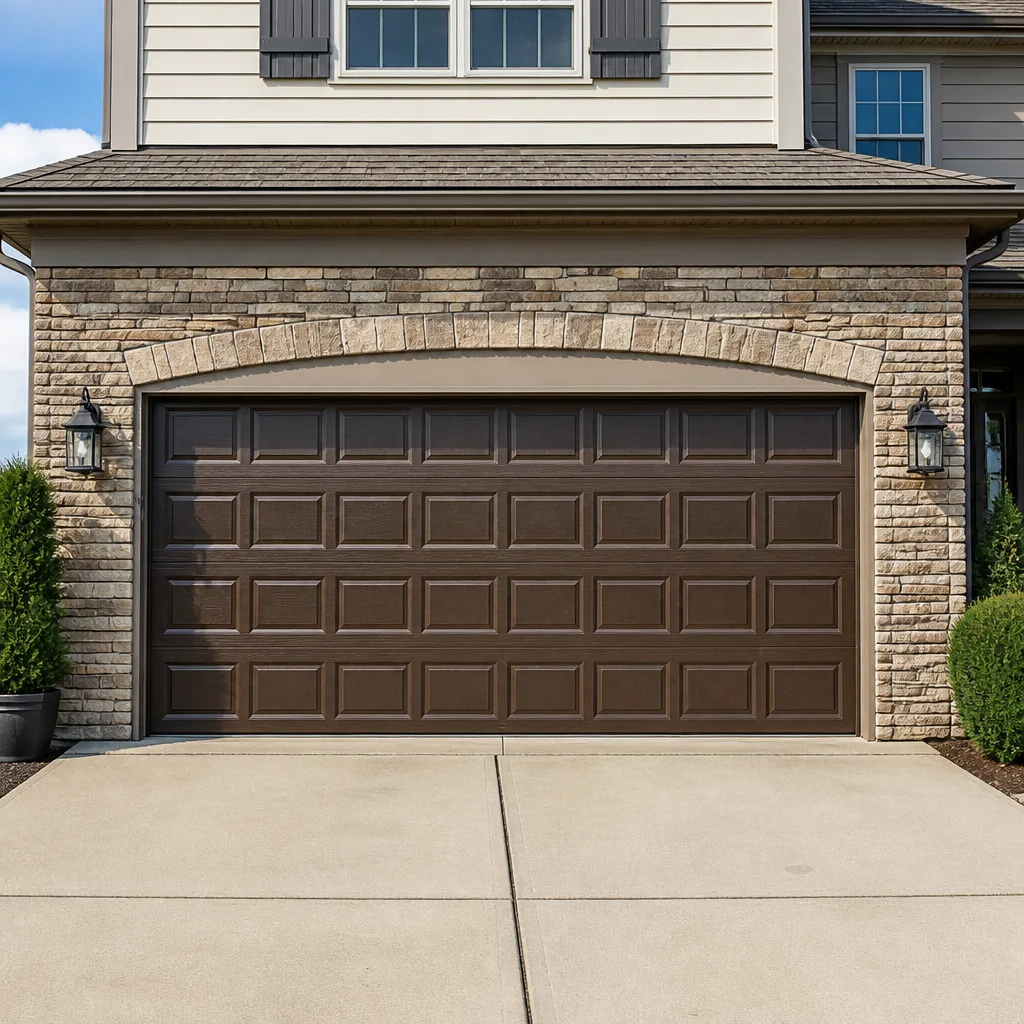 Raised-panel steel
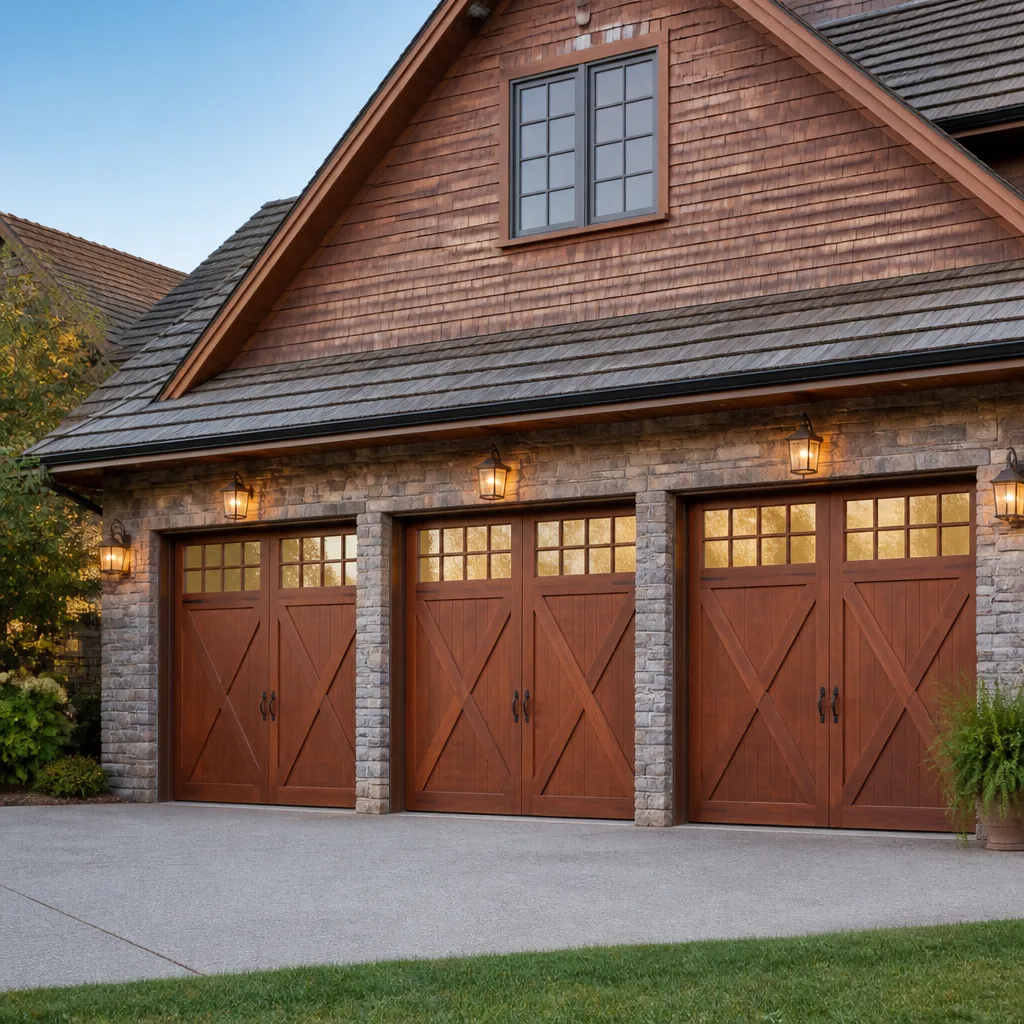 Carriage house
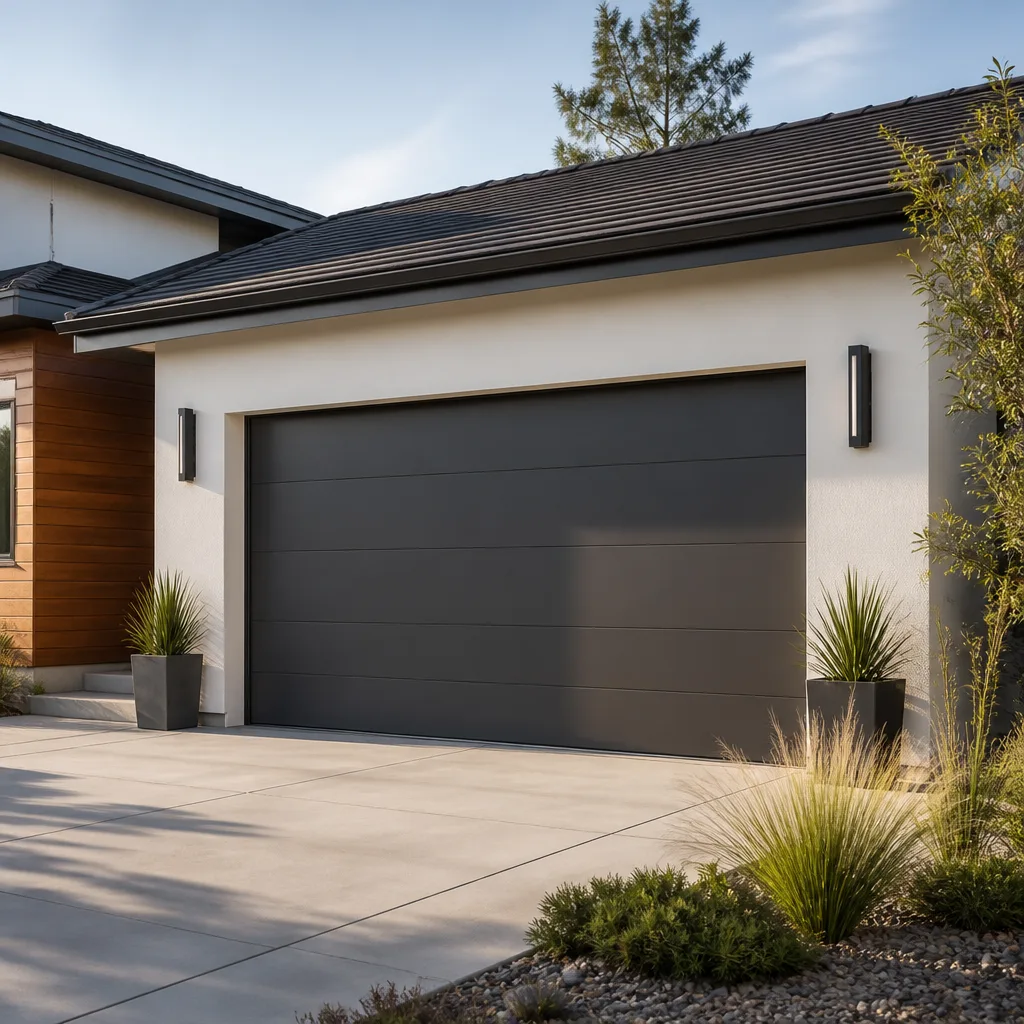 Modern flush
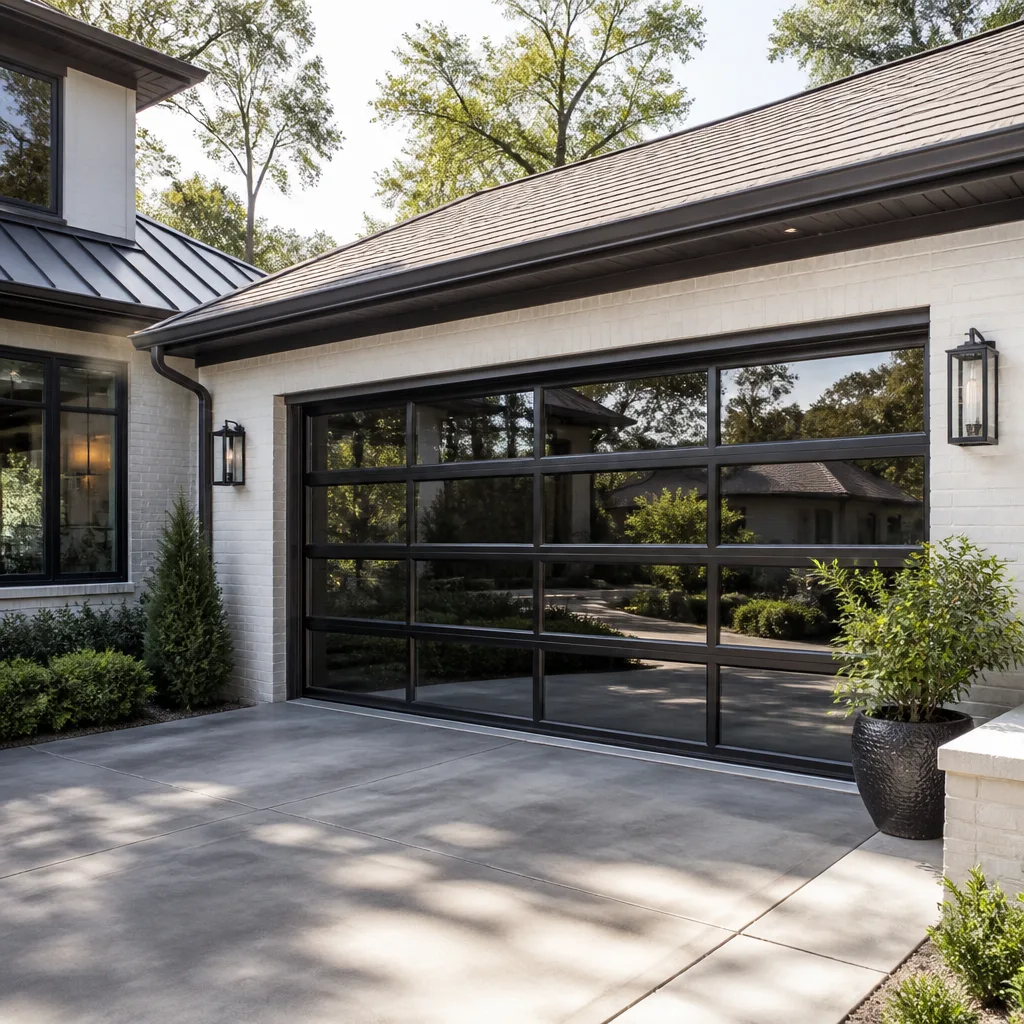 Full-view glass
 LiftMaster openers
 Chamberlain openers
Full 25-point door and opener safety check with every visit - springs, cables, rollers, tracks, and your LiftMaster or Chamberlain opener included
You get a price before we start. It does not change when the truck arrives.
Get your free estimateGarage Door Repair Maintenance Checklist for Irvine Homeowners
Irvine gets 281 sunny days a year, and that sunshine is doing more damage to your garage door than any Midwestern winter ever could. Ultraviolet radiation breaks down weatherstripping, oxidizes painted steel, and embrittles the rubber seals on a timeline that surprises most homeowners. This checklist is built around what actually fails in Irvine’s specific microclimate, from Santa Ana wind stress to the thermal expansion cycles that wear out springs faster than most national maintenance guides account for. You’ll learn what to check monthly, what needs attention seasonally, and which problems demand Garage Door Repair by a technician’s hands before they turn into a $400 emergency call.
Quick Answer
A garage door maintenance checklist for Irvine homeowners should prioritize UV damage inspection on weatherstripping, painted steel panels, and torsion springs; monthly lubrication with dry-climate products that won’t attract dust; track and cable tension checks before Santa Ana wind season; and balcony-style edge-seal replacement every 2-3 years. Most Irvine garage doors need weatherstrip replacement and spring inspection twice as often as doors in coastal or four-season climates because heat and UV accelerate polymer degradation.
Styles & brands we work with
Table of Contents
- UV Damage: The Irvine-Specific Wear Pattern Most Checklists Miss
- The Monthly 10-Minute Inspection Routine
- Weatherstripping Replacement Timeline for Irvine’s Sun Exposure
- Lubrication Products That Actually Work in Irvine’s Dry, Dusty Air
- Santa Ana Wind Season Preparation Protocol
- Spring Tension Inspection Intervals for SoCal Thermal Cycles
- HOA Compliance Documentation for Garage Door Repairs in Irvine
- Panel Warping and Paint Oxidation: What’s Normal and What’s Structural
UV Damage: The Irvine-Specific Wear Pattern Most Checklists Miss
When you read a garage door maintenance checklist written for a national audience, it typically spends three paragraphs on ice buildup, rust from road salt, and cold-weather lubricant viscosity. None of that applies to Irvine. What does apply is photodegradation, and it’s the single most common cause of premature garage door component failure across Orange County.
Ultraviolet light breaks down the molecular bonds in rubber, vinyl, and certain paints. In practical terms, that means your weatherstripping doesn’t wear out from friction. It wears out from sitting in direct sunlight at 90 degrees while absorbing UV radiation that stiffens and cracks the material. We’ve replaced weatherstripping on Irvine garage doors that was under three years old but already crumbling at the corners. The same door in a shaded neighborhood might have gotten five more years out of those seals.
Here’s what UV degradation looks like on each component:
- Bottom seal (astragal): Hairline cracks along the compression bulb, often first visible at the outermost edges where the seal curves up the door jamb
- Side and top weatherstripping: Chalky white residue on the surface, loss of flexibility, gaps appearing at corners when the door is closed
- Painted steel panels: Fading, chalking (the powdery film that rubs off on your hand), and eventually exposed primer where oxidation has eaten through the finish
- Torsion spring coils: Surface rust is rare in Irvine’s low-humidity air, but paint coatings on springs can crack under sustained heat, exposing the underlying steel to the minimal moisture that does exist
- Opener housing and exterior hardware: Plastic components inside the opener can become brittle over 5-7 years of attic-level heat exposure in an uninsulated garage
The frustrating part is that UV damage is cumulative and largely invisible until it’s already advanced. A homeowner checks their door in March, sees intact rubber, and doesn’t look again for a year. By the following March, the seal has split completely. The fix is calendar-based inspection, not condition-based inspection. Mark your calendar twice a year for UV checks, regardless of whether the door “looks fine.”
In our experience working on garage door systems across Irvine’s neighborhoods, from Woodbridge to Northwood, the doors facing south or southwest generally need weatherstripping replacement 12-18 months sooner than doors facing north. Orientation matters more than most homeowners realize.
The Monthly 10-Minute Inspection Routine
This is the routine we recommend to every customer who wants to avoid emergency repair bills. It takes ten minutes, requires no tools beyond your eyes and ears, and catches about 80% of the failures that lead to major garage door repairs. Do this on the first weekend of every month.
Step 1: Visual scan from inside the garage, door closed.
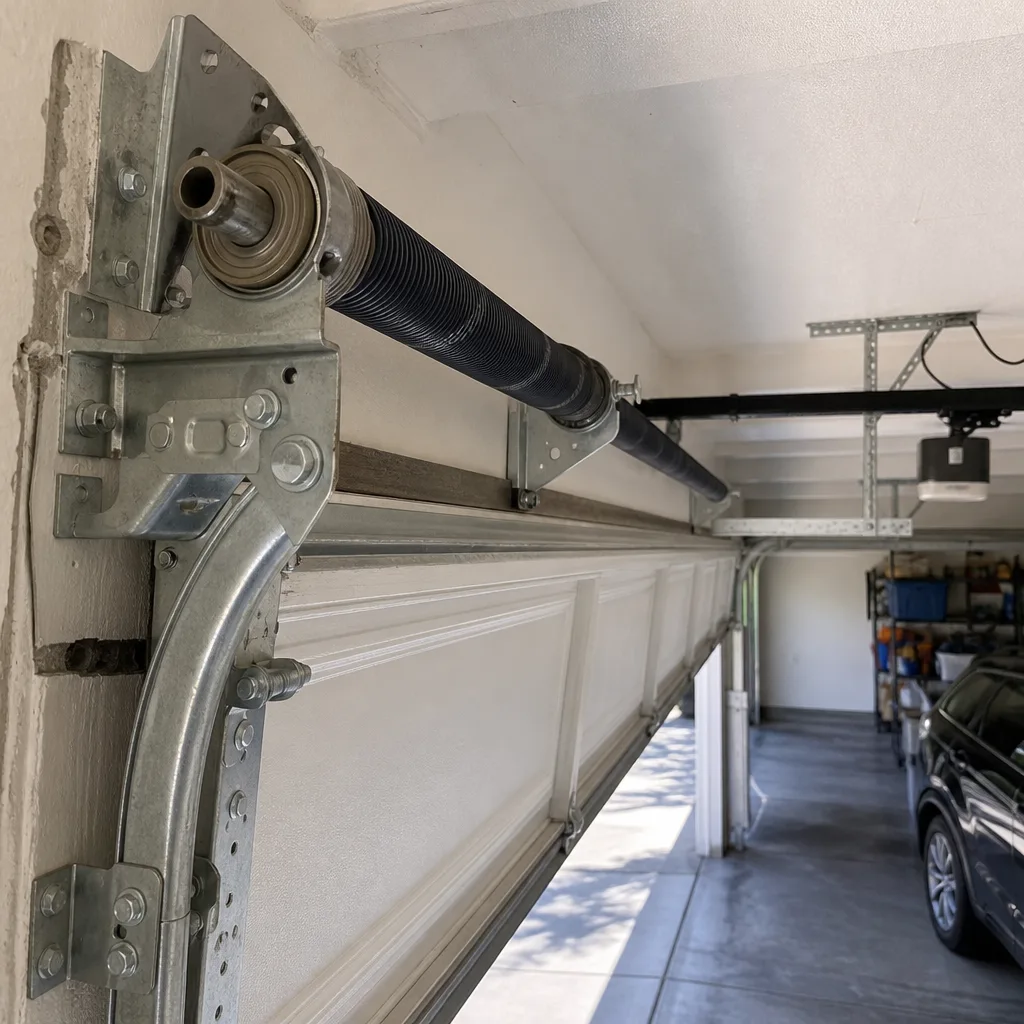
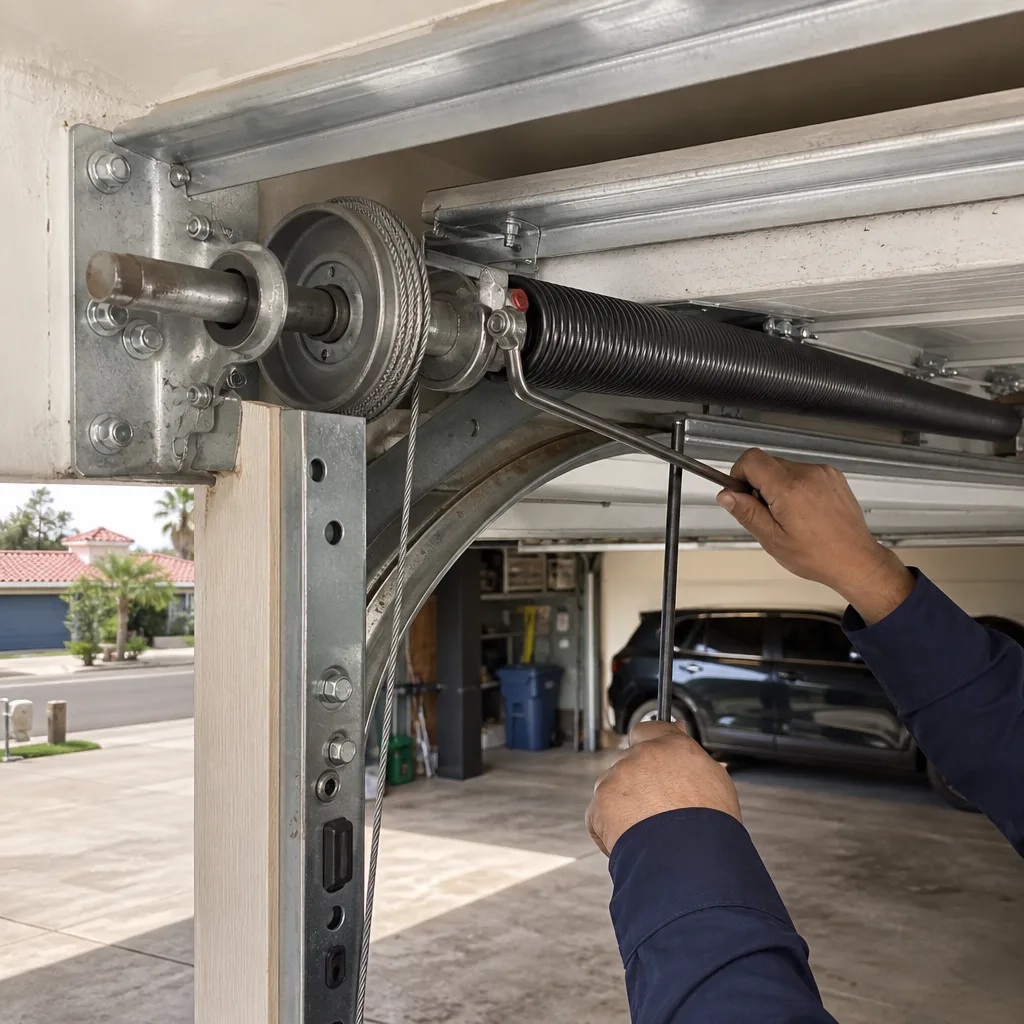
- Look at the torsion spring above the closed door. It should show no gaps between coils. A gap wider than the thickness of a dime on any part of the spring means the spring is beginning to fail.
- Check the cable drums at both ends of the torsion tube. The cables should be wound evenly, with no overlapping wraps, no fraying strands, and no visible slack.
- Run your eyes down both tracks. They should be perfectly vertical, and the bolts holding them to the wall should all be present and tight-looking. Any shifted track means the door has been bumped or the wall anchors are loosening.
Step 2: Door operation test.
- Open the door all the way, then close it. Listen for scraping, grinding, or rattling that wasn’t there last month. A new noise is always meaningful, even if the door still operates.
- Watch the door from inside as it moves. It should stay centered in the opening without wobbling side-to-side. Any lateral movement means track misalignment or worn rollers.
- Check the balance: with the opener released and the door halfway open, the door should hold its position or drift only slightly. A door that drops or rises on its own has a spring tension problem that will soon fail completely.
Step 3: Exterior check.
- Walk around to the outside and check the bottom seal where it meets the garage floor. You’re looking for daylight. Any visible gap lets in dust, insects, and heat on an Irvine afternoon.
- Press your thumb into the side weatherstripping. It should be springy, not hard. Brittle rubber means replacement is due.
- Look at the panel surface for new dents, scratches that have exposed bare metal, or bubbling that indicates the paint is separating from the substrate.
This routine catches problems while they’re cheap to fix. A binding roller that goes unnoticed for six months becomes a snapped cable and a door that won’t open. A spring with a visible gap becomes a spring that breaks while your car is inside.
For reference, our Carriage House Garage Door Co home service area includes all of Irvine’s villages and master-planned communities, and we’ve walked enough of these monthly checklists with homeowners to know that consistency is what separates a 20-year door from a 12-year door.
Weatherstripping Replacement Timeline for Irvine’s Sun Exposure
Most manufacturers rate their vinyl weatherstripping for a 5-7 year service life. In Irvine’s UV intensity, that number drops to 2-4 years on sun-exposed sides. Here’s the thing: weatherstripping is one of the least expensive components on your garage door system, and ignoring it causes the most expensive problems.
When your bottom seal fails, you don’t just get a warmer garage. You get:
- Fine dust accumulating on everything stored in the garage, including the air filter on your HVAC system if it’s in the garage
- Pest intrusion points. Ants and spiders in Irvine follow temperature gradients, and a garage door with a cracked seal is an open invitation
- Water intrusion during the occasional heavy rainstorm, which can soak drywall, rust tools, and create mildew in the humid aftermath
- Higher ambient temperatures that force your opener’s motor to work marginally harder with every cycle, quietly shortening its lifespan
The replacement timeline we recommend for Irvine:
- Bottom seal (astragal): Replace every 2 years if the door faces south or west; every 3-4 years if facing north or shaded
- Side and top vinyl weatherstripping: Replace every 3-5 years. The top seal typically lasts longest because the header provides partial shade
- PVC stop molding with integrated seal: This is the better product for Irvine. Metal stop molding with separate vinyl strip tends to fail at the corner joints first
One caveat worth knowing: universal weatherstripping sold at big-box stores in Irvine is often manufactured for a range of climates and doesn’t hold up as well as the commercial-grade material a garage door company stocks. The urethane-based bottom seals we install on Irvine garage doors are formulated for high-UV environments and typically last 30% longer than vinyl equivalents. If you’re replacing seals yourself, check the material spec before you buy.
Lubrication Products That Actually Work in Irvine’s Dry, Dusty Air
Here’s a maintenance mistake we see constantly in Irvine: homeowners lubricate their garage door with WD-40, or with a heavy grease that works fine in humid climates, and then wonder why the tracks are gummed up with a gritty paste six months later. Irvine’s air is dry and dusty. The wrong lubricant attracts that dust, and the dust turns into an abrasive compound that accelerates wear on rollers, hinges, and bearings.
The correct approach is straightforward:
- Use a lithium-based or silicon-based spray lubricant designed specifically for garage doors. These dry to a non-tacky film that doesn’t attract dust. Brands like Blaster and 3-IN-ONE make garage-door-specific formulas that are readily available in Irvine.
- Never lubricate the track itself. Tracks are meant to be clean and dry. Lubricating tracks is a persistent myth. Your rollers should roll on the track, not slide on it. If you see enough friction on the track to think it needs lubrication, the real problem is a worn roller or a track alignment issue, and those need correction, not grease.
- Lubricate the moving metal contact points: hinge pins, roller ball bearings (not the nylon wheel surface), spring coils, bearing plates at both ends of the torsion tube, and the opener rail if it’s a chain or screw drive. Belt drives don’t take lubrication.
- Frequency: every 3 months. In Irvine’s low humidity, metal-on-metal contact points dry out faster than in coastal cities. Less frequent lubrication means more friction heat, more noise, and premature wear on hinges and rollers.
One more Irvine-specific note: if you live near open space, a canyon, or any of the city’s preserved agricultural edges, you’ll get more wind-blown dust and pollen accumulating in the door’s moving parts. Homes in Orchard Hills and Portola Springs near the foothills deal with this more than homes in the flatlands. For those homeowners, a quick wipe-down of the hinges and rollers with a dry cloth before lubricating makes the lubricant last longer and work better.
If your opener is noisy, it may not be a lubrication issue at all. We handle Garage Door Opener Repair in Costa Mesa and surrounding Orange County, and a surprising number of “lubrication requests” turn out to be worn gears or failing capacitors. But for routine maintenance, the quarterly lubrication cadence above will keep most doors operating quietly and smoothly.
Santa Ana Wind Season Preparation Protocol
Irvine sits in a wind corridor. When Santa Ana winds kick up in October and November, sustained gusts of 30-40 mph are common, with stronger bursts in canyon-adjacent neighborhoods. Your garage door is a 16-foot-wide sail. If the cables, springs, and tracks aren’t in balance, those wind events will find the weak point and exploit it.
Here’s the preparation checklist we recommend every September, before wind season starts:
- Test door balance manually. Release the opener and move the door to the halfway point. It should stay put or drift only a few inches over 10 seconds. A door that wants to drop or rise is already out of balance, and that imbalance multiplies the stress on cables when wind pushes against the panels.
- Inspect cable tension on both sides. Look at the cables where they wind onto the drums near the top of each track. Winding should be even, with no gaps, no overlap, and no fraying. Compare the two sides visually. One loose cable means the door is cocked slightly in the opening, and the first strong wind will twist it further.
- Check bottom seal integrity. A complete bottom seal keeps wind from getting under the door and lifting it from below. If your seal is split at the corners, replace it before October. This is the single cheapest wind protection you can buy.
- Tighten track bolts. Put a wrench on every bolt that connects the vertical tracks to the wall framing and check for movement. Over years of door cycles, these bolts work loose. A gust of wind against a door with loose track anchors can pull the track right off the wall.
- Test the automatic reversal. Place a piece of 2×4 flat on the floor under the door’s path and close the door. It should reverse within two seconds of contacting the wood. Wind season is when doors sometimes slam unexpectedly from a strong gust, and a functioning reversal mechanism prevents property damage and serious injury.
The Santa Ana wind protocol takes about 20 minutes. It’s the highest-return maintenance time you’ll spend all year if you live in a wind-exposed part of Irvine. And if you find anything that looks wrong, cable tension especially, call a professional before wind season. A cable replacement under controlled conditions is a $150-$250 repair. A cable that snaps during a 45-mph gust turns into a door off its track, usually with damaged panels, and a bill that starts at $600.
Our full-service approach means if the wind does catch your door, Garage Door Repair in Costa Mesa and Irvine is handled by the same team that does the maintenance, not a hand-off to some other company. That continuity matters when you’re diagnosing wind damage, because we know what your door looked like before the storm.
Spring Tension Inspection Intervals for SoCal Thermal Cycles
Torsion springs are the muscle of your garage door system. They counterbalance the weight of the door so the opener only has to do a fraction of the work. When a spring fails, it usually fails catastrophically, with a bang loud enough to hear from inside the house. The key maintenance insight is that springs don’t fail randomly. They fail on a predictable cycle determined by use and temperature, and in Irvine, that cycle has a specific pattern.
A standard torsion spring is rated for 10,000 cycles. An average Irvine household opens and closes the garage door 4-6 times a day, which translates to 1,500-2,200 cycles per year. At that rate, a standard spring lasts 5-7 years. But two Irvine-specific factors compress that timeline:
Thermal expansion stress: Irvine’s diurnal temperature swings average 20-30 degrees. That’s not extreme by desert standards, but the garage door itself is a large thermal mass. The steel panels expand during the day and contract at night. The spring, mounted above the door inside the garage, experiences its own expansion cycle. These differential rates mean the spring is under slightly different tension at 2 p.m. than it is at 5 a.m., and the daily cycling adds micro-stress to the metal’s fatigue point.
Heat-hardened garage environments: In an unconditioned Irvine garage, summer interior temperatures routinely exceed 110 degrees. The spring’s steel grade is engineered for a specific tensile strength at normal operating temperatures. Sustained high heat accelerates the fatigue process. We’ve seen springs in Irvine garage doors with 7,000-8,000 cycles on them that measured as fatigued as springs with 12,000 cycles in coastal homes.
The inspection protocol:
- Visual gap check every 3 months: stand inside the garage with the door closed and look at the spring along its full length. A healthy spring shows no gaps between coils. A gap anywhere means the spring is in early failure and should be replaced before it snaps.
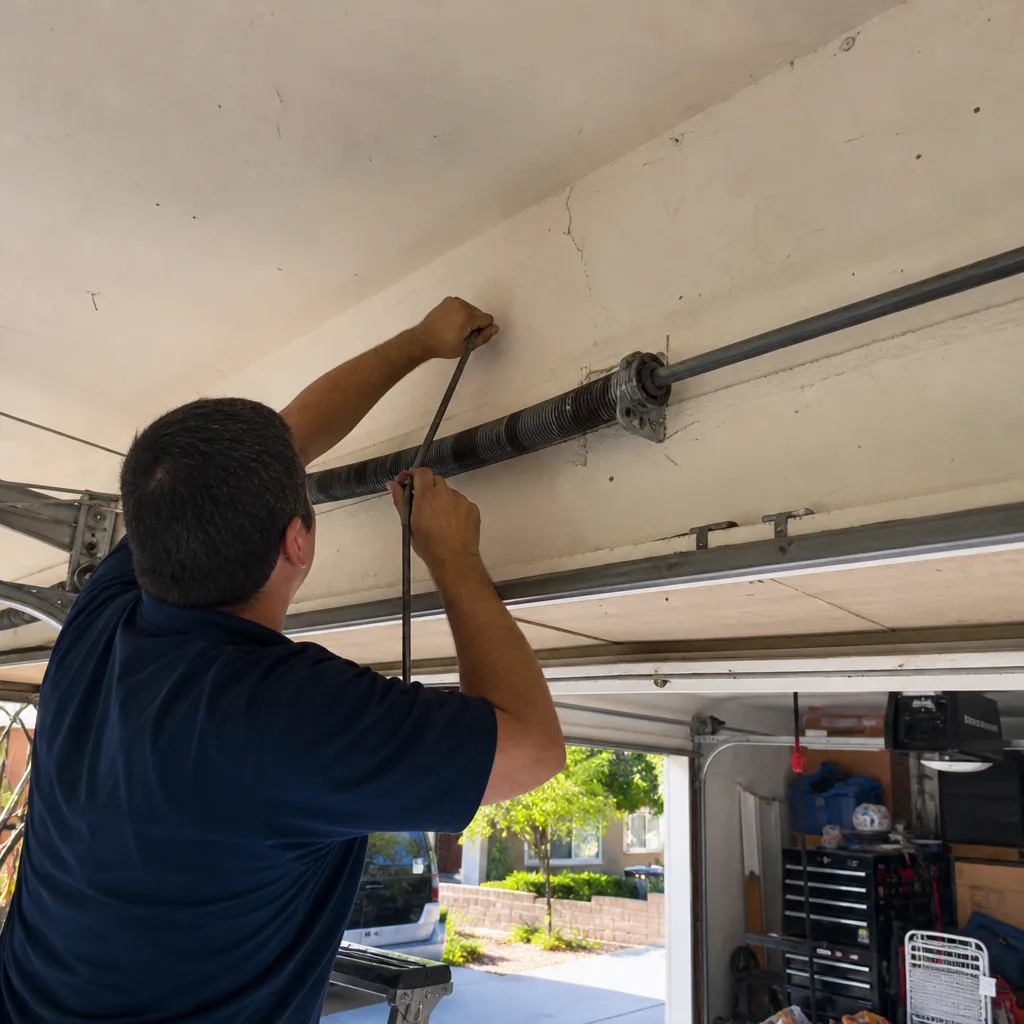
- Annual professional inspection: have a technician verify spring torque against the door’s actual weight using the proper tools. Door weight changes subtly over time if you add insulation panels, paint layers, or a strut. The spring tension should be calibrated to the measured weight, not the original spec.
- Replacement interval planning: if your spring is 6-7 years old and you’ve noticed the door feeling heavier when manually lifted, budget for replacement. Don’t wait for the bang.
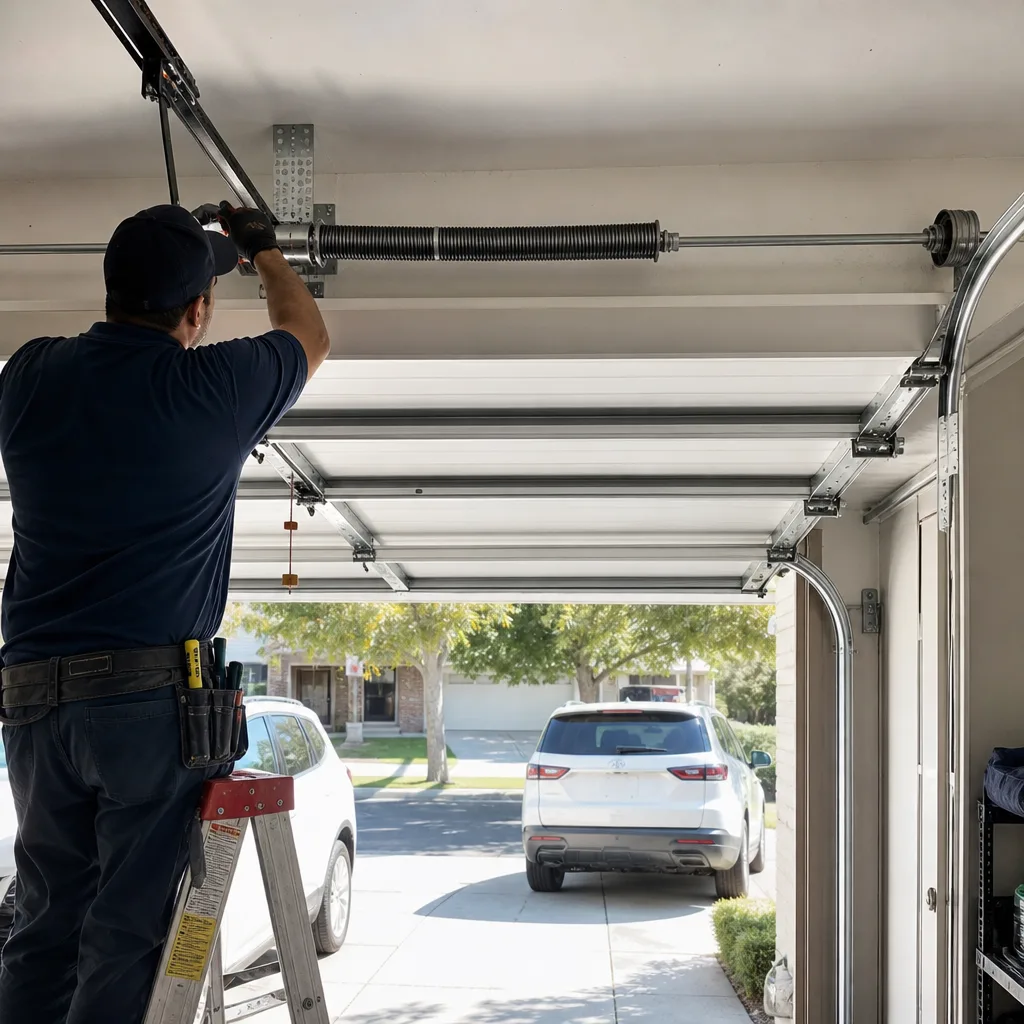
A critical safety note: torsion spring replacement involves working with components under 150+ pounds of torque. This is one job where DIY is genuinely dangerous. We don’t give step-by-step instructions for spring replacement in this guide for that reason. In Irvine, spring replacement is typically a same-visit repair when a technician already has the right spring on the truck, and it’s done for a flat quoted price before any work begins. If your spring looks questionable, call us for an inspection rather than pushing it through another season.
HOA Compliance Documentation for Garage Door Repairs in Irvine
Irvine has one of the highest concentrations of HOA-governed communities in California. If you live in Woodbury, Great Park, Stonegate, or any of the other master-planned villages, your CC&Rs almost certainly regulate what you can and can’t do to the visible exterior of your home, including your garage door. Navigating that paperwork is part of the maintenance reality here, and it’s worth doing correctly the first time.
What most HOAs in Irvine regulate:
- Door color and finish: any repainting or replacement must match the approved palette for your specific tract. Even a garage door repair that requires panel replacement must match the existing color exactly.
- Door style and material: many Irvine HOAs require specific architectural styles (Spanish, Mediterranean, Craftsman, etc.) and prohibit changing the door type without design review.
- Visible hardware: some HOAs regulate handle, hinge, and decorative strap styles for consistency across the community.
- Opener visibility: belt versus chain drive is not visually regulated, but any exterior keypad or sensor placement sometimes is.
The documentation process for maintenance and repair:
- Check your CC&Rs first. Before any repair that changes visible components, read the current architectural guidelines. If your HOA has an online portal, download the PDF and search for “garage door.”
- Submit a design review application for anything beyond like-for-like repair. Replacing a broken panel with an identical panel is typically maintenance, not alteration. But replacing a door with a different material, style, or color is always an alteration and needs pre-approval.
- Keep a service record. If a technician replaces a spring, a cable, or weatherstripping, it’s purely mechanical and needs no HOA notification. But keep the invoice anyway. If the HOA later questions why the door looks different, you have documentation that any changes were in-kind.
- Photograph before and after. If you do need HOA approval, submit photos of the current door, the proposed replacement, and the confirmed paint code. The faster the architectural review committee can see exactly what you’re doing, the faster they’ll approve it.
We work on Amarr and Wayne Dalton doors extensively in Irvine, and both manufacturers offer specific models and finishes that are pre-approved in many of the city’s larger HOAs. If you’re planning a door replacement rather than a repair, our Garage Door Installation in Costa Mesa team can help you verify HOA compliance before you order. It’s a step that saves weeks of back-and-forth and potential rejection.
Panel Warping and Paint Oxidation: What’s Normal and What’s Structural
Steel garage door panels in Irvine deal with a specific form of heat stress: asymmetric thermal expansion. The outside face of the panel sits at 140+ degrees on a summer afternoon while the inside face stays at garage temperature, typically 85-100 degrees. That 40-60 degree difference between two surfaces of the same steel sheet creates a constant thermal bowing force. Over years, panels can warp slightly, and the paint finish can oxidize faster than on any other exterior surface of your home.
Here’s how to distinguish normal wear from structural problems:
Normal paint oxidation: Fading is expected on any exposed metal surface in Irvine after 3-5 years. The finish gets a chalky feel, colors lose saturation, and if you rub the surface with a clean cloth, a fine powder comes off. This is cosmetic. The panel remains structurally sound. Paint restoration or a professional repaint is a maintenance decision, not an emergency.
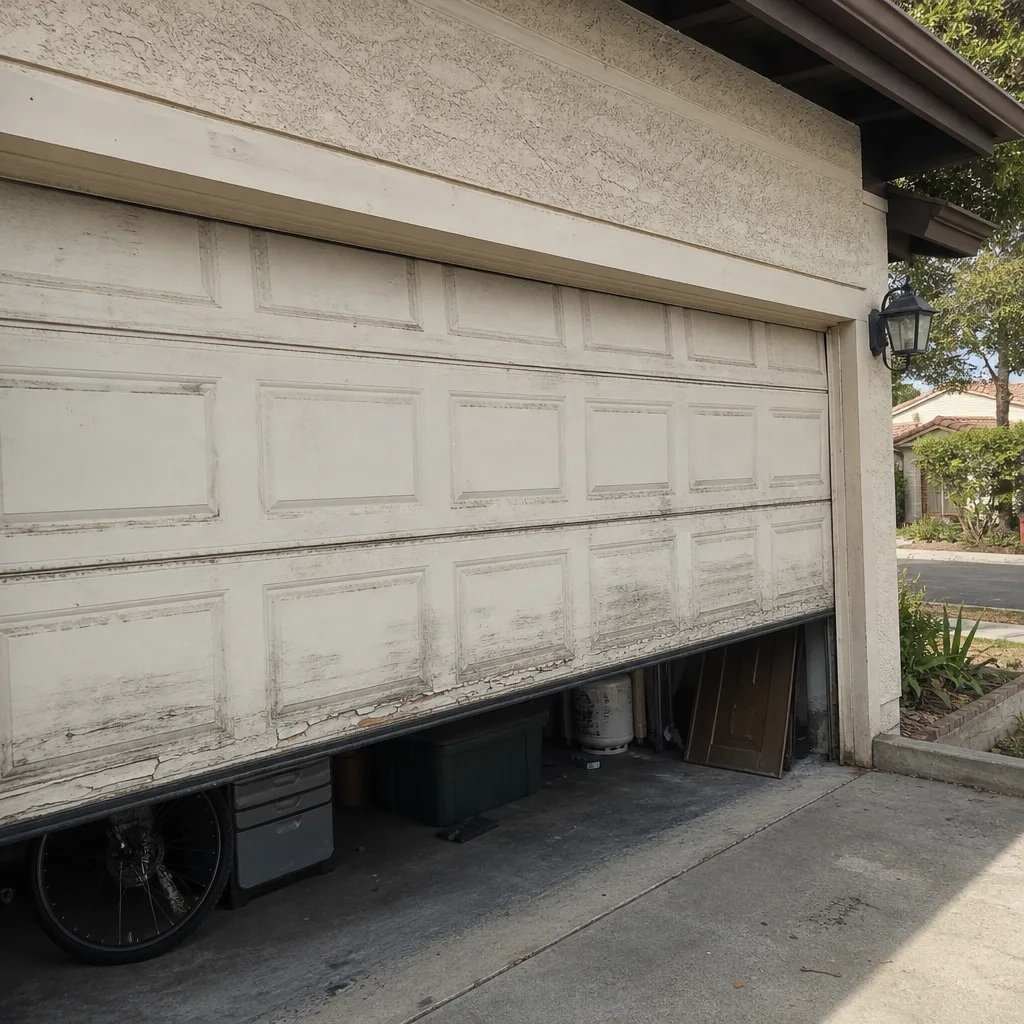
Structural paint failure: When the paint film cracks and peels away from the steel substrate, exposing bare metal, the panel is now vulnerable to corrosion. Even in Irvine’s dry air, bare steel will eventually rust, and once rust starts, it spreads under the surrounding paint. Exposed bare metal on a garage door panel needs attention within 3-6 months. It’s a repair-scale problem, not a replace-scale problem, if caught early.
Minor panel warping: A slight bow of 1/8-inch or less across a 24-inch panel width is common in Irvine doors with sustained southern exposure. The door still seals correctly, still operates smoothly, and the warping is only visible at certain light angles. This is cosmetic and typically needs no correction.
Structural panel warping: If a panel bows more than 1/4-inch, if you can see visible gaps at the panel seams when the door is closed, or if the door buckles when closing, the panel is failing. This usually happens when a door has been hit by a vehicle, or when the original steel gauge was too thin for the installation. A structurally warped panel means the door is no longer sealing, the sections are no longer aligned, and the longer you wait, the more adjacent panels will be stressed into failure.
One note on panel materials: steel is the most common door material in Irvine by a significant margin, but wood and wood-composite doors exist in the city’s older neighborhoods and in some custom homes. Wood doors have an entirely different UV and heat profile, and they need resealing or repainting every 2-3 years in Irvine’s sun. If you own a wood door, treat its finish like you’d treat a wood fence or deck. The maintenance calendar is much more aggressive for wood than for steel.
We service Craftsman and Raynor equipment across Irvine, and both brands offer decent steel-gauge options. But panel longevity in this climate really comes down to the initial installation quality and ongoing seal maintenance. A 24-gauge panel that gets regular seal replacement and prompt paint touch-up will outlast a 26-gauge panel that’s ignored, every time.
Common Mistakes to Avoid
- Using the wrong lubricant. WD-40 is a solvent, not a lubricant, and it strips any protective film off metal contact points. In Irvine’s dusty air, WD-40-treated hinges become sticky dust magnets within weeks. Use a lithium or silicone garage door lubricant.
- Ignoring a small gap at the bottom seal. That half-inch of daylight at the corner of the door is how scorpions, spiders, and hot air get into your garage. In Irvine, a torn bottom seal on a south-facing door goes from minor to major within one summer.
- Painting over bare metal without prep. Slapping touch-up paint over oxidized or rusted steel seals in the problem rather than fixing it. The rust continues underneath, and the paint peels within months. You need to sand, prime, and paint, not just paint.
- Adjusting spring tension without a tension gauge. Springs are the one component where “eyeballing it” genuinely risks injury. Spring adjustment without the right tools and tension measurement is one of the most dangerous things a homeowner can do in a garage. Don’t do it.
- Assuming the opener motor is the problem when the door is slow. A sluggish door is usually a balance problem, a track problem, or a worn roller problem. The opener is just the motor; it’s often the last thing to fail. Replacing an opener without checking the door balance is spending $400 to fix a symptom instead of a cause.
- Skipping HOA review before a visible change. If you install a new door in a color that isn’t HOA-approved, you’ll be required to repaint or replace it at your own cost. The design review process exists for a reason in Irvine, and it costs nothing to check first.
See the difference
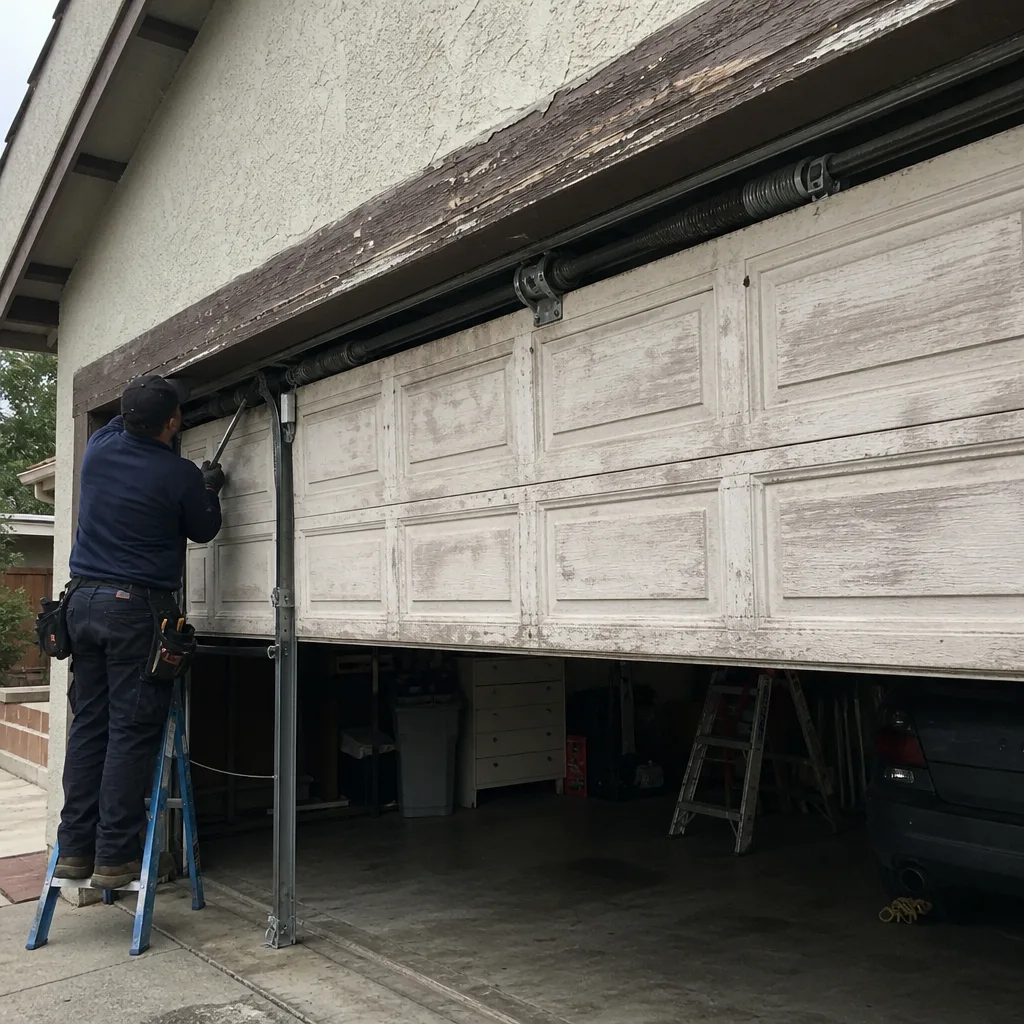 Before
 After
 Before
 After
 Before
 After
When to Call a Professional
If your door makes a loud bang during operation, the cable is frayed, the spring shows a visible gap, or the door won’t stay in the half open position, stop using it and call a technician. These are signs of imminent spring or cable failure, and the door can drop without warning. Other situations that warrant a professional: a door that’s come off its track, any opener issue that involves electrical wiring, or a panel that’s dented deeply enough to compromise the door’s structural integrity. Carriage House Garage Door Co offers free estimates in Irvine, call (866) 472-7503, and we’ll give you a written price before any work starts. We’re licensed and insured, and we work on LiftMaster, Chamberlain, Genie, Clopay, Amarr, Wayne Dalton, Craftsman, and Raynor, so your existing equipment is our specialty, not a reason to upsell you on a new system.
Frequently Asked Questions
Every 3 months in Irvine’s dry, dusty climate. The low humidity means metal contact points lose their lubrication film faster than in coastal areas, and the fine dust that blows through the city accumulates on any tacky surface. Use a lithium or silicone spray designed for garage doors, never WD-40, and never lubricate the track itself. If you still hear grinding after lubricating, call (866) 472-7503 for an inspection; The lubrication may not be the problem.
A basic maintenance visit, including inspection, lubrication, and minor adjustments, typically runs $95-$175 in Irvine depending on the provider and the scope of the work. If the technician finds worn parts that need replacement, like rollers, cables, or weatherstripping, those are quoted separately before the work is done. Carriage House Garage Door Co provides upfront pricing, so you’ll know the exact cost before we start, and estimates are free.
Yes, with clear limits. The monthly inspection routine, weatherstripping replacement, and basic lubrication are all DIY-accessible. What you should not do yourself is anything involving torsion spring adjustment or replacement, cable replacement, or track realignment. Springs store enough tension to cause serious injury if improperly handled. For those jobs in Irvine, call a licensed technician who carries the right tools and knows the correct torque values.
Standard torsion springs in Irvine last 5-7 years, somewhat less than in cooler climates, because sustained heat and daily thermal expansion cycles accelerate metal fatigue. If your door is used 4-6 times daily and the spring is older than 6 years, budget for replacement even if it looks fine. High-cycle springs rated for 25,000 cycles are available from most manufacturers and typically double the replacement interval.
Heat expansion changes the clearance tolerances in your door’s moving parts. Metal tracks expand, rollers fit more tightly, and any minor alignment issue becomes more audible when temperatures rise. If the noise is worse in summer than winter, the first thing to check is track alignment and roller wear, not the opener motor. A quiet winter door that gets loud in June in Irvine usually has a track or roller problem that summer heat is exposing.
For mechanical repairs like spring replacement, cable work, or opener repair, no HOA approval is needed. These are considered maintenance, not alterations. But any change to the visible appearance of the door, including panel replacement with a different color or finish, door replacement, repainting in a new color, or adding decorative hardware, requires design review in most Irvine HOAs. Check your CC&Rs before starting any visible work to avoid having to redo it.
The Bottom Line
The garage door maintenance checklist for Irvine that actually matters is calibrated to UV exposure, dusty dry air, Santa Ana wind season, and HOA compliance. It is not a generic national checklist with a different city name pasted on top. The work itself is not complicated: monthly visual inspections, quarterly lubrication with the correct products, annual balance checks, and weatherstripping replacement on a 2-4 year cycle. What makes the difference is consistency and knowing what you’re looking at. Most expensive garage door failures in Irvine could have been caught 6-12 months earlier with a simple visual check. Do the monthly inspection. It’s the cheapest insurance policy you’ll ever have for one of the largest moving parts in your home. For more guides & resources, visit our blog.
Written by the team at Carriage House Garage Door Co, serving Irvine since 2013.