

Last updated October 30, 2026
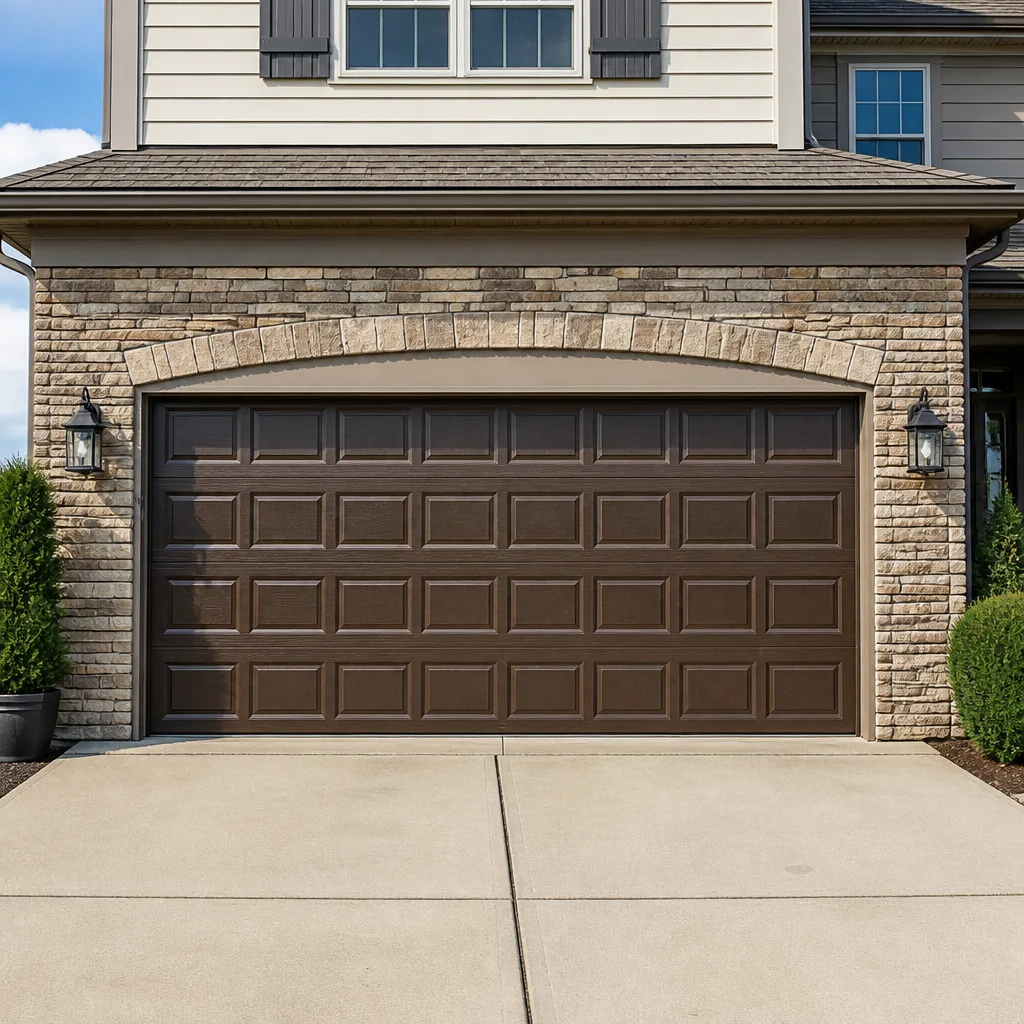 Raised-panel steel
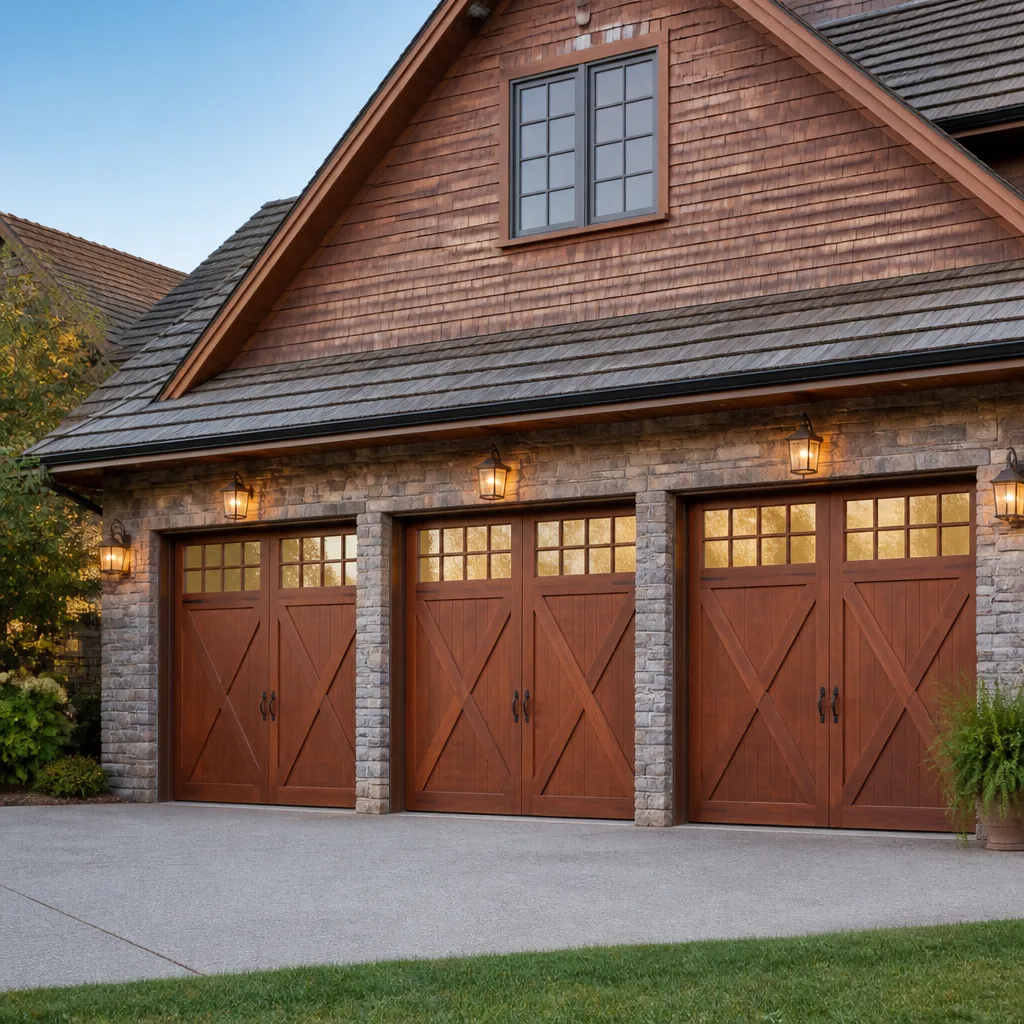 Carriage house
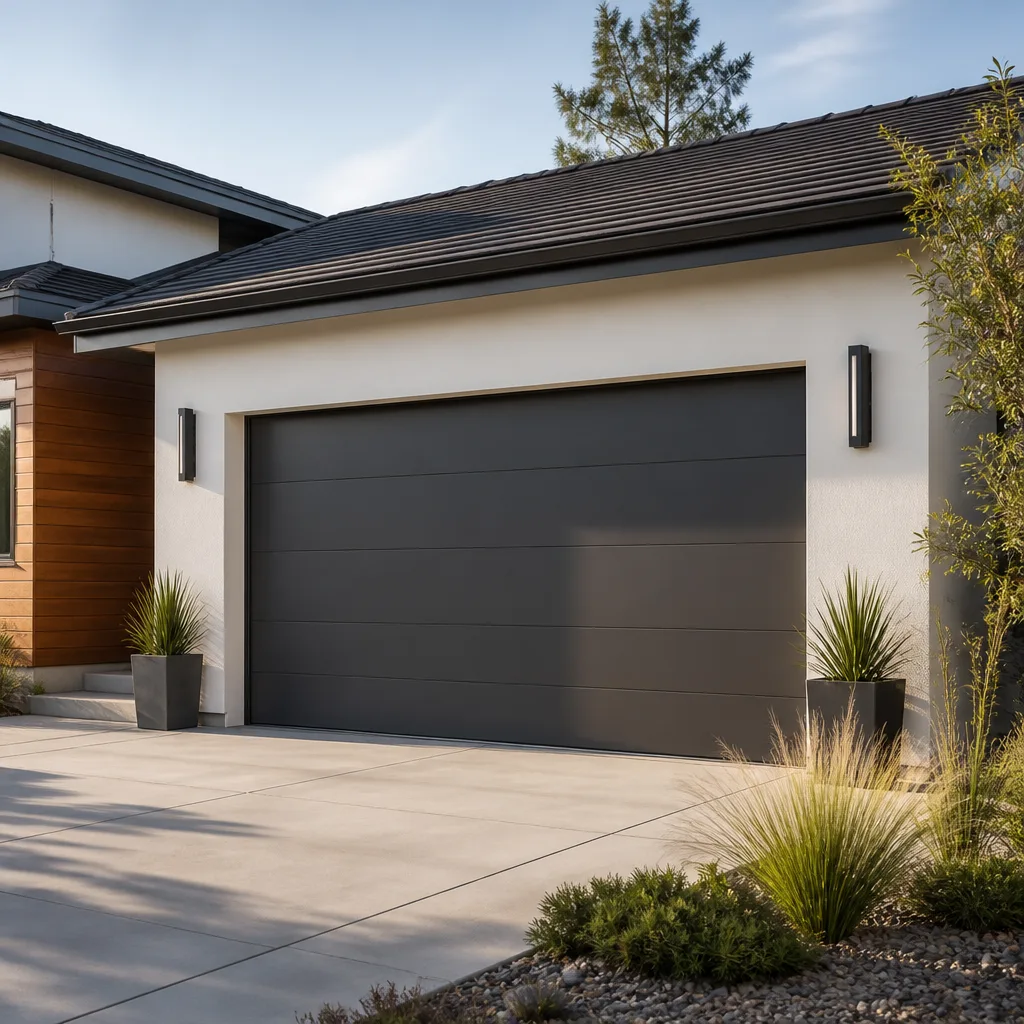 Modern flush
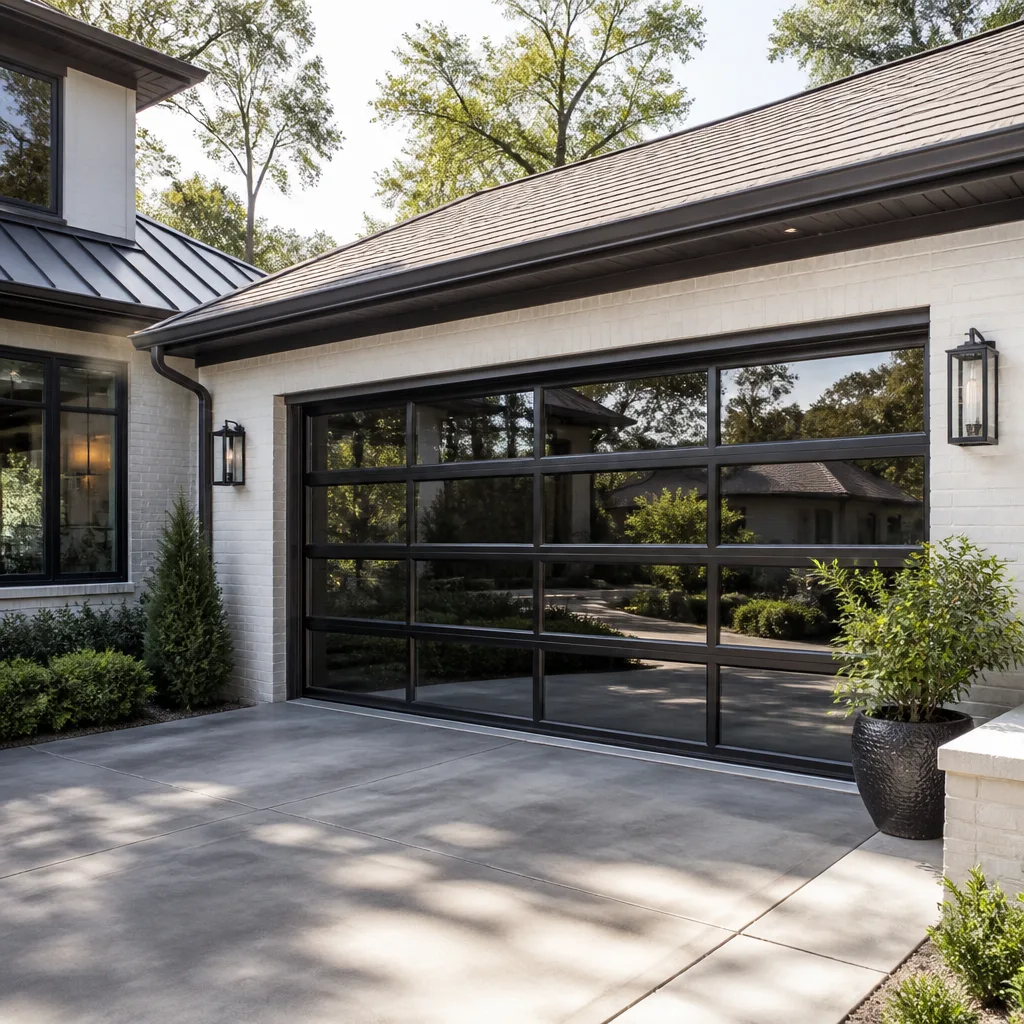 Full-view glass
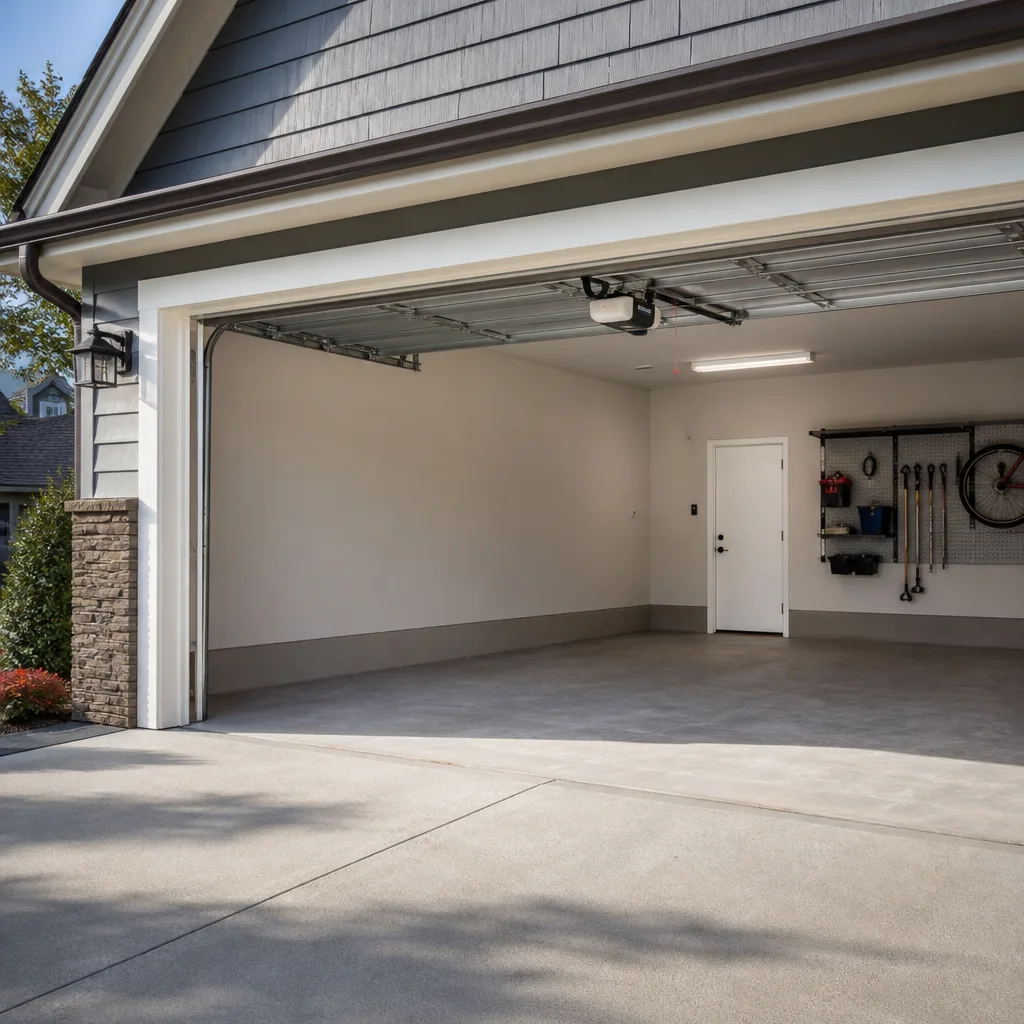 LiftMaster openers
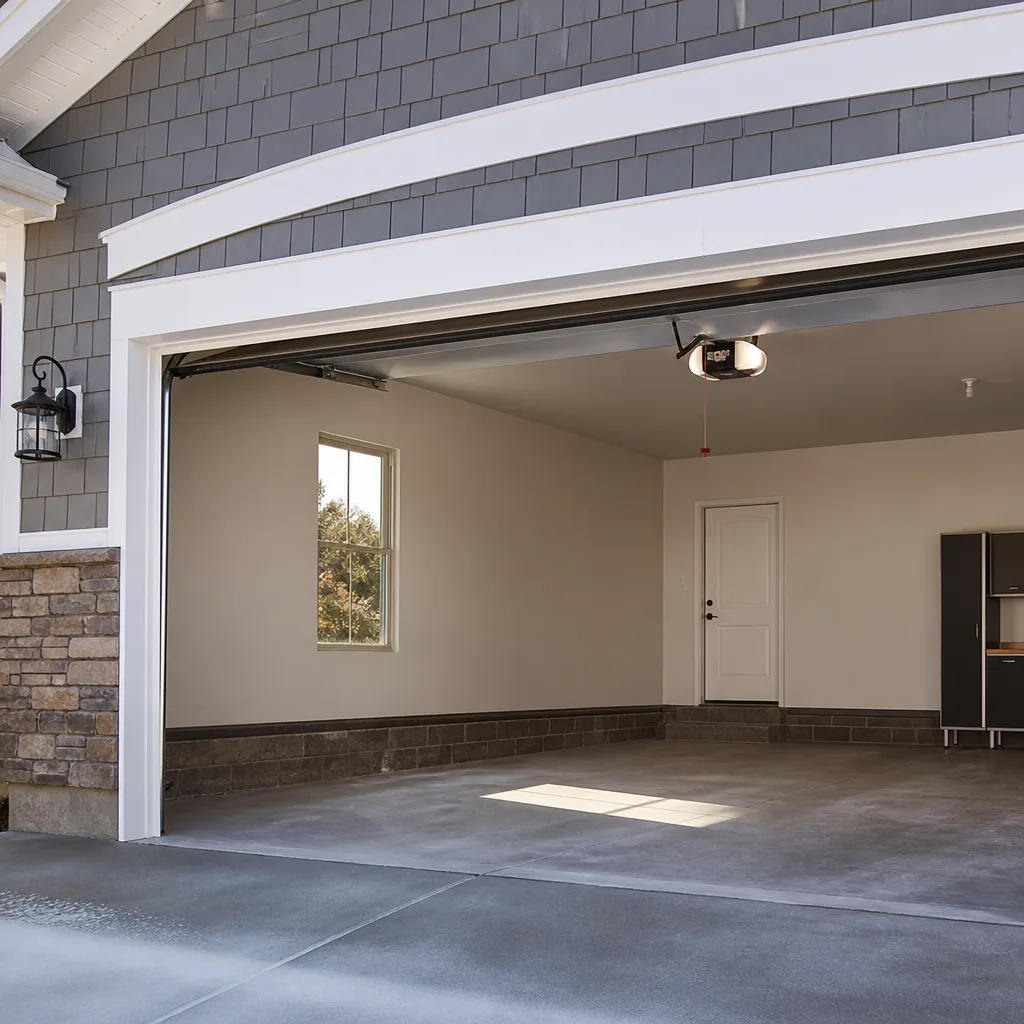 Chamberlain openers
Full 25-point door and opener safety check with every visit - springs, cables, rollers, tracks, and your LiftMaster or Chamberlain opener included
You get a price before we start. It does not change when the truck arrives.
Get your free estimateThe Complete Garage Door Repair Guide for Irvine Homeowners
Most garage door repair guides are written for a fictional average homeowner in a fictional average city. Irvine has over 90 active homeowners associations, Mediterranean humidity swings that punish metal components, and thousands of homes built in narrow construction windows by the same handful of builders. That means the repair calculus here is genuinely different. This guide maps Irvine’s specific conditions, from salt air corrosion to HOA panel-match requirements, onto a practical repair framework you can actually use. We’ve serviced doors in every Irvine village, from Woodbridge to Portola Springs, and what breaks here follows patterns no generic guide covers.
Styles & brands we work with
Quick Answer
Garage door repair in Irvine, CA typically costs between $180 and $340 for common spring and cable work, with most repairs completed in a single visit. Irvine homeowners face two complications most guides ignore: HOA architectural guidelines that dictate which replacement parts and panels are approved, and coastal-adjacent humidity that accelerates corrosion on springs and cables. Carriage House Garage Door Co works on eight major brands including LiftMaster, Chamberlain, Genie, and Clopay, and we diagnose Irvine-specific issues correctly the first time.
Table of Contents
- How Irvine’s Climate Actually Wears Down Garage Doors
- HOA Rules in Irvine: What You Can and Cannot Replace
- The Irvine Tract-Home Spring Pattern
- What Garage Door Repair Costs in Irvine, CA
- DIY Repairs vs. Professional Work: An Honest Breakdown
- Documenting Repairs for HOA Compliance and Warranty Continuity
- Common Mistakes to Avoid
- When to Call a Professional
- Frequently Asked Questions
- The Bottom Line
How Irvine’s Climate Actually Wears Down Garage Doors
Irvine sits roughly six miles from the Pacific at its closest point. That proximity drives a humidity cycle most homeowners don’t notice until metal starts failing. Mornings bring marine layer moisture that condenses on cold steel. Afternoons burn it off with dry heat. This daily wet-dry cycle is harder on garage door hardware than either constant humidity or constant dryness would be.
Torsion springs are the primary casualty. Standard galvanized springs start showing surface rust within two to three years in Irvine’s coastal-adjacent air, even when the door is otherwise in good shape. Rust doesn’t just look bad. It creates micro-pitting on the spring coil, which concentrates stress and leads to fractures at unexpected cycle counts. In our experience, Irvine springs fail an average of 18 to 24 months earlier than the same spring would last in, say, Rancho Cucamonga or Riverside, where the air is consistently drier.
Cables and rollers face the same accelerated timeline. Cable rust typically appears first at the bottom bracket, where moisture pools after morning condensation runs down the track. Once rust sets in, friction increases, and a frayed cable under load becomes a genuine safety concern. Rollers with steel bearings grow noisy and rough. Nylon rollers with sealed bearings handle Irvine’s humidity significantly better and are worth the modest upgrade on any door that gets daily use.
The track itself is generally powder-coated and resists rust well, but the fasteners holding it to the wall are often zinc-plated only. We routinely see track lag bolts with surface corrosion in coastal-adjacent Irvine villages like Newport Coast and Corona del Mar. That’s a structural issue, not just a cosmetic one, because a corroded lag bolt can lose its bite in the wall stud and allow the track to shift.
HOA Rules in Irvine: What You Can and Cannot Replace
Irvine is one of the most HOA-dense cities in Southern California. The vast majority of detached homes and essentially all condo and townhome communities fall under an architectural review committee that governs exterior modifications. Garage doors fall squarely within that authority in most communities. Before you replace a panel, let alone a whole door, you need to know what your CC&Rs say.
Most Irvine HOAs require that replacement garage doors match the existing neighborhood palette. That often means specific paint colors, panel profiles, and even window lite patterns are prescribed. Woodbridge HOAs, for instance, typically specify a narrow range of neutral tones and may require recessed panel designs rather than raised panels. Quail Hill and Turtle Ridge communities often restrict the use of windows in garage doors for privacy and light-pollution reasons. Portola Springs HOAs frequently require that carriage-house style doors follow specific architectural patterns already established in the community.
The practical impact on repair is straightforward. If a door panel is damaged beyond repair, the replacement panel must match not just your door but your HOA’s approved specifications. That’s not always as simple as calling the original manufacturer. Panel colors fade, manufacturers discontinue lines, and older doors may have custom paint that’s no longer in production. We’ve matched panels in Irvine where the original door was still under warranty but the exact panel color had been discontinued, which meant a color-match paint application after installation.
What many homeowners don’t realize is that even spring and opener replacement can trigger HOA review in stricter communities, not because the parts are visible, but because the HOA wants a record that the work was done by a licensed contractor with insurance. Some Irvine HOAs keep a list of pre-approved vendors. While Carriage House Garage Door Co is not an exclusive vendor for any single HOA, our licensed, insured, and brand-agnostic approach generally satisfies architectural committee requirements. It’s worth emailing your management company before scheduling major work so you’re not dealing with a violation notice after the fact.
The Irvine Tract-Home Spring Pattern
Irvine’s housing stock was built in waves. The Ranch and early University Park homes date from the 1960s and 1970s. Woodbridge and Westpark followed in the 1980s. Northwood and Turtle Rock saw significant build-out in the 1980s and 1990s. The Great Park neighborhoods and Portola Springs represent the 2000s and 2010s. Here’s the thing most guides miss: homes built in the same wave tend to have the same doors, the same springs, and the same failure schedules.
A 1980s Woodbridge home with its original double-wide door likely has a pair of torsion springs sized for a wood door of that era. Those springs were commonly rated for roughly 10,000 cycles, and at the typical Irvine usage rate of three to four cycles per day, that’s about seven to nine years. The original springs on those doors have long since been replaced, but the replacement springs are often undersized or incorrectly matched because a previous technician ordered by door weight alone rather than by the full spring engineering calculation.
What we see repeatedly in Irvine tract homes is a pattern of mismatched spring pairs. One spring fails, a homeowner calls a technician who replaces only the failed spring, and now the door has one new spring and one old spring. The old spring is carrying more load than it should, which accelerates its failure. In Woodbridge, Westpark, and the older Northwood tracts, mismatched spring pairs are among the most common findings on service calls.
Parts availability is another tract-home advantage. Because so many Irvine homes share door builders from the same era, common parts like specific hinge numbers, bottom brackets, and even entire panel sections for certain Clopay and Amarr models are well understood. A technician who knows Irvine tract homes knows which doors came standard on which streets. That’s genuine parts fluency, not a generic parts catalog lookup.
We work on your brand. Most Irvine tract homes have doors from Clopay, Amarr, Wayne Dalton, or Raynor, with openers from LiftMaster, Chamberlain, Genie, or Craftsman. A brand-agnostic specialist can diagnose across all of those without pushing you toward a replacement you don’t need. That matters when the goal is a repair, not a sales call.
What Garage Door Repair Costs in Irvine, CA
Repair pricing in Irvine runs slightly above the Orange County average because of HOA compliance requirements, multi-story homes that require specialized ladder work, and the need for corrosion-resistant parts. Here’s what we see across Irvine’s neighborhoods as of 2025.
| Repair Type | Typical Irvine Range | Notes |
|---|---|---|
| Single torsion spring replacement | $180 – $240 | Includes spring, labor, and balance check |
| Double torsion spring replacement | $280 – $360 | Recommended when one spring fails on a two-spring door |
| Cable replacement (per side) | $110 – $160 | New galvanized or stainless cable, pulley inspection |
| Roller replacement (full set) | $90 – $140 | Nylon rollers with sealed bearings recommended for Irvine humidity |
| Hinge replacement (per hinge) | $40 – $70 | Includes hardware and alignment check |
| Track realignment | $110 – $160 | Includes fastener replacement and lubrication |
| Opener circuit board replacement | $150 – $250 | Brand-dependent; LiftMaster and Chamberlain boards are more common |
| Full door panel replacement (single panel) | $280 – $500 | Varies by door brand, paint match, and HOA approval status |
These prices are the quoted-before-work ranges we operate within for Irvine service calls. You’ll know your exact cost before any work starts. No one works on your door and then surprises you with a different invoice. That’s basic trade practice, and any company that operates otherwise should be avoided.
One more Irvine-specific note: if your door faces west toward the ocean, expect corrosion-related replacement intervals to run shorter than the table above. Salt air from the coast doesn’t stop at the city limits; it drifts inland along the San Diego Creek corridor and affects hardware in University Park and Turtle Rock almost as much as in Newport Coast.
DIY Repairs vs. Professional Work: An Honest Breakdown
Some garage door maintenance is genuinely safe for a careful homeowner. Some is not. Most guides blur this line. We won’t.
Safe for most homeowners:
- Lubricating hinges, rollers, and springs with white lithium grease or a silicone-based garage door lubricant
- Tightening visible hinge bolts and track fasteners with a socket wrench
- Testing the auto-reverse safety sensors and cleaning the sensor lenses
- Replacing the opener remote batteries and reprogramming the remote
- Weatherstripping replacement along the bottom of the door
Not safe. Not borderline. Call a trained professional:
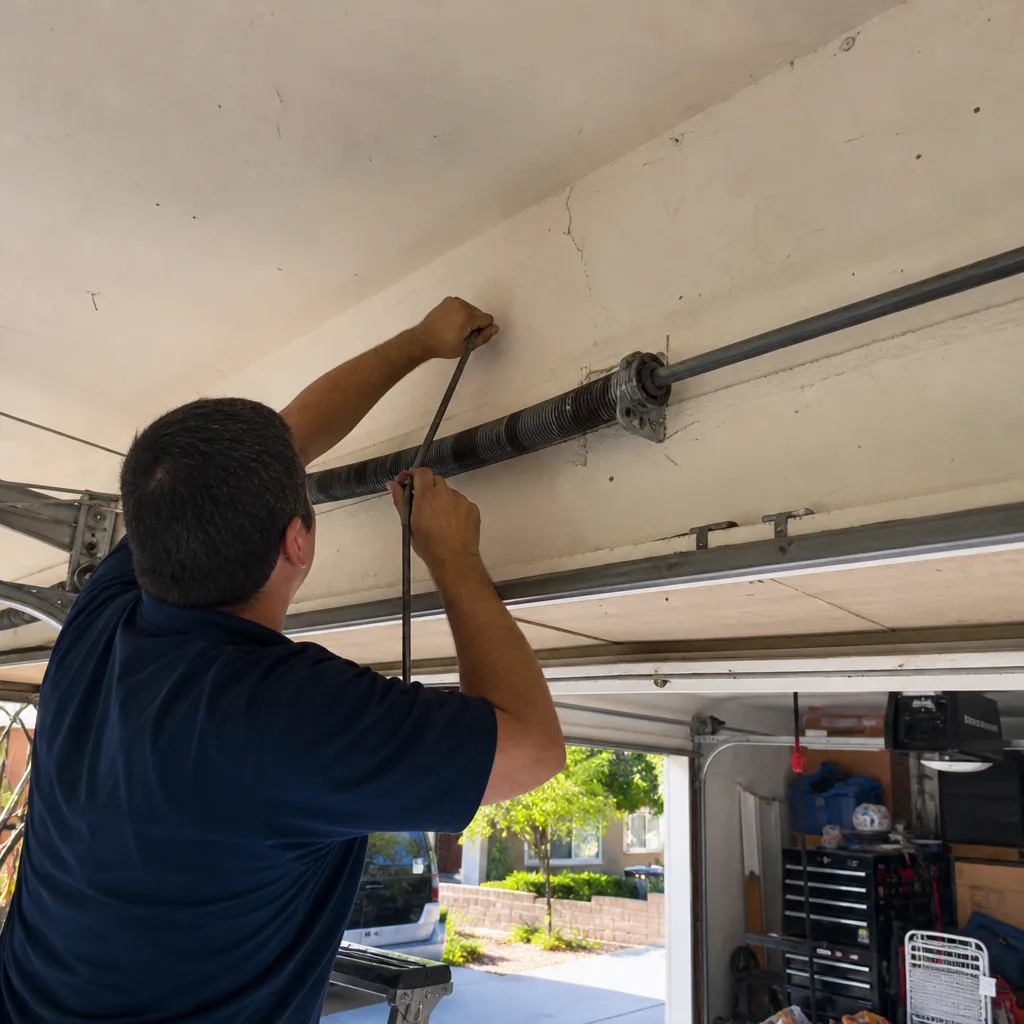
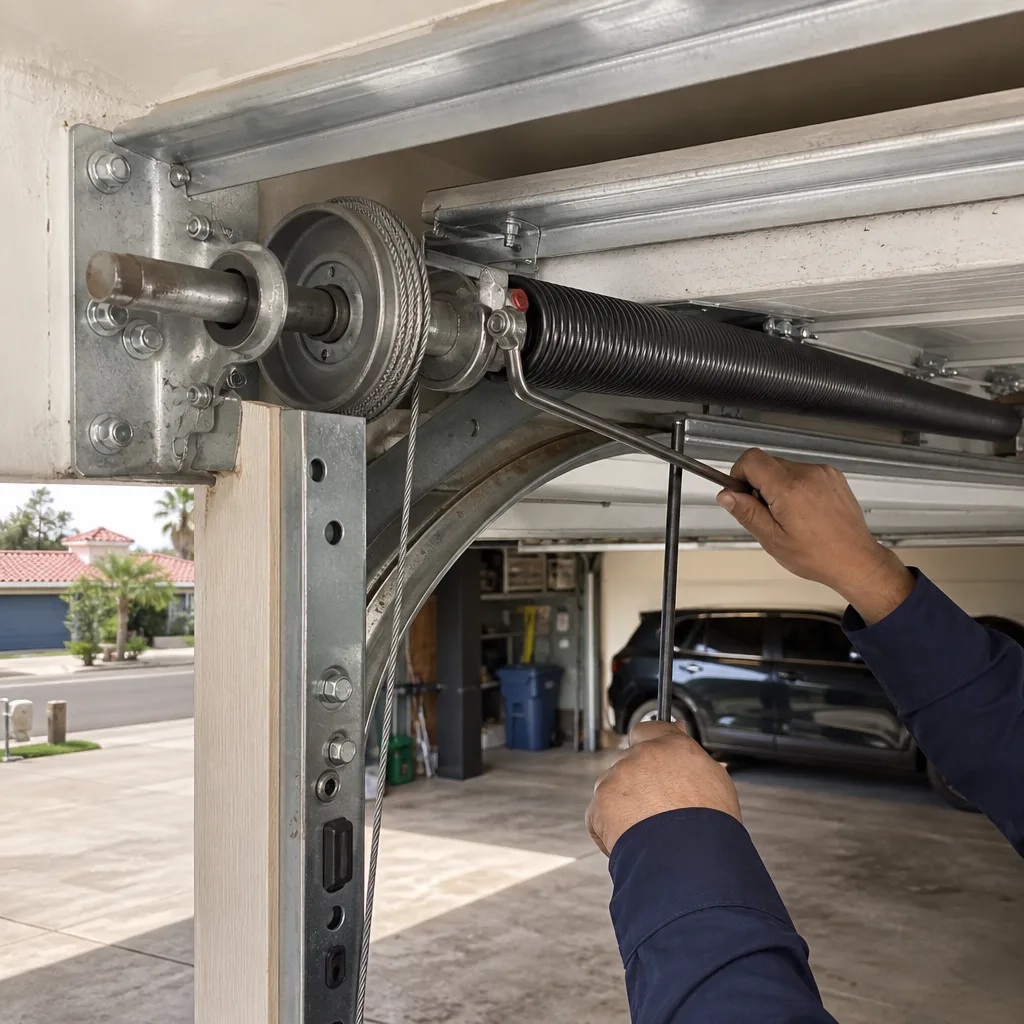
- Anything involving torsion springs. Torsion springs are under thousands of pounds of torque. A spring that lets go while you’re working on it can cause serious injury or death. Even removing a tension spring without the proper winding bars is genuinely dangerous.
- Cable replacement. The cables work in concert with the springs. If the spring has tension, the cable has tension. A frayed cable that snaps under load whips with enough force to cut.
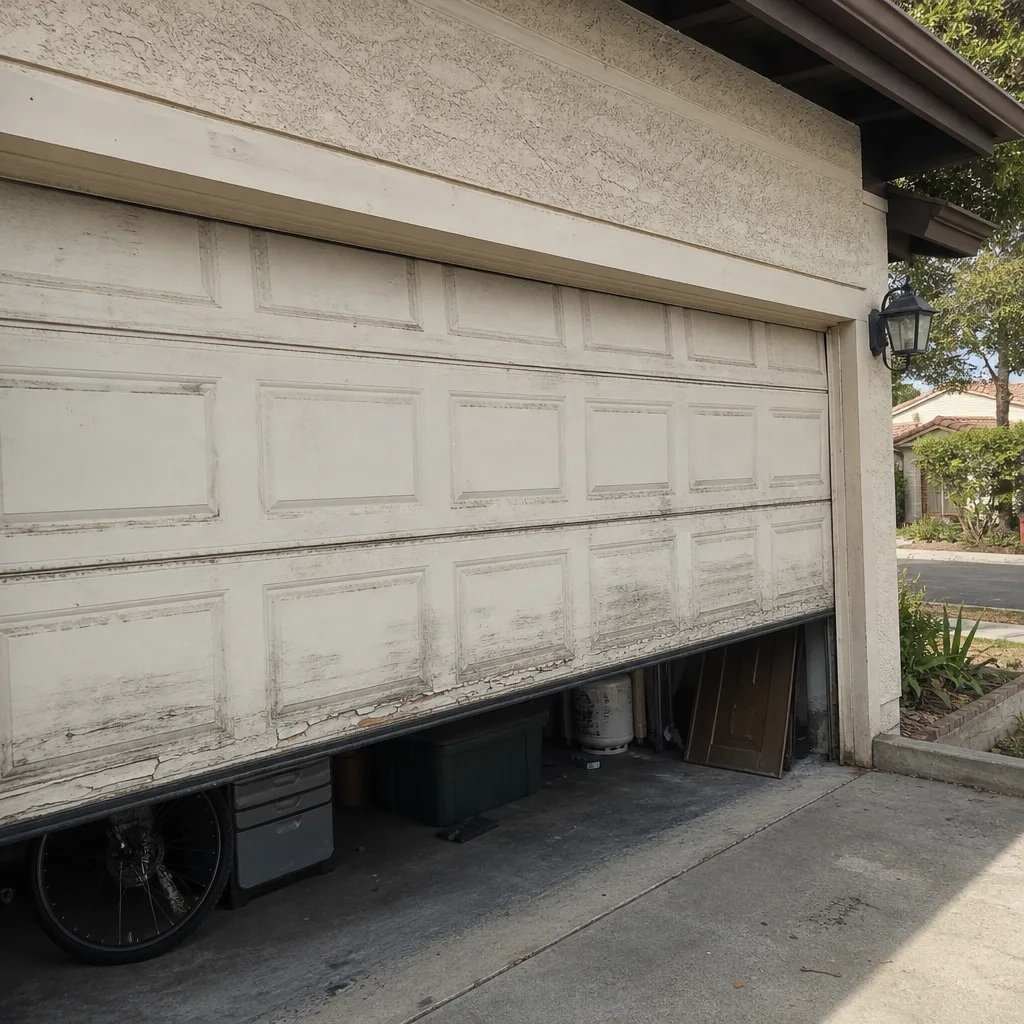
- Track realignment on a door that’s off its rollers. The weight of a 150 to 300 pound door is not something you want to be underneath when the track lets go.
- Opener motor replacement. The opener is wired into your home’s electrical system and mounted overhead. Improper installation leads to doors that reverse unexpectedly or don’t stop when they should.
Here’s the honest math. The money you save on a DIY spring repair, if it goes wrong, is a fraction of the cost of a new door, a hospital bill, or both. We’ve seen springs fail on Irvine homeowners who were mid-repair. The injuries are real, and the cost of the attempted savings is irrelevant afterward. Professionals carry the right tools, the right training, and the right insurance. Some risks are not worth taking to save two hundred dollars.
Documenting Repairs for HOA Compliance and Warranty Continuity
Most Irvine homeowners never think about repair documentation until the HOA asks for it or the manufacturer denies a warranty claim. Here’s how to handle both from the start.
Step 1: Before work begins, photograph the door. Document the full door from the street, the inside of the door, the spring assembly, the opener unit, and any visible damage. These photos establish a baseline and are useful for HOA records and insurance claims.
Step 2: Confirm the parts being used. If your door is under manufacturer warranty, ask whether the repair uses OEM parts or generic equivalents. Warranty coverage sometimes depends on this distinction. We work on your brand and match replacement parts to the original specification whenever possible.
Step 3: Request a detailed invoice. A proper invoice lists the parts replaced, the brand and model of those parts, the date of service, and the technician’s name. This is the document your HOA management company will ask for if there’s ever a question about the work.
Step 4: Photograph the finished work. After the repair, repeat your baseline photos. The before-and-after set protects you if the HOA later claims the work altered the home’s appearance without approval.
Step 5: Send repair records to your HOA management office. Even if your community doesn’t require it, having the repair on file with the HOA protects you during a future sale. Irvine homebuyers are HOA-savvy, and a garage door repair with no record can become a disclosure headache.
Step 6: Keep everything for at least five years. Springs, openers, and panel replacements often carry warranties of five years or more. If the part fails early, your documentation is what gets it covered.
Common Mistakes to Avoid
- Replacing only one spring on a two-spring door. Both springs have the same cycle count. When one breaks, the other is close behind. A single-spring replacement saves money today and costs more in a few months when the second spring fails and you pay a second service call.
- Choosing a door or panel color without checking HOA specs first. Irvine HOAs can require you to repaint or replace an unapproved door at your own expense. Check the CC&Rs before you commit to a color, even if it looks identical to the old one.
- Using WD-40 on springs and rollers. WD-40 is a solvent, not a lubricant. It washes away the protective grease that keeps your springs running smoothly. Use white lithium grease or a garage-door-specific silicone spray instead.
- Ignoring a slow-moving door. A door that opens slower than it used to is telling you something. It might be a tired opener, a binding roller, or a spring losing tension. Ignoring it turns a $40 hinge replacement into a $300 spring replacement.
- Letting rust go unchecked on cables and brackets. Rust that starts as surface discoloration becomes fraying cable strands and cracked brackets. Catching it early means a cleanup and lubrication. Catching it late means a cable replacement and possibly a door off its track.
- Hiring a technician who doesn’t know your door brand. A LiftMaster opener and a Clopay door require different diagnostic approaches. A brand-agnostic specialist who works across eight major brands diagnoses faster and avoids unnecessary replacement recommendations.
- Not testing the auto-reverse after any repair or installation. The auto-reverse is the primary safety feature on your door. After any work, place a 2×4 on the ground under the door and close it. The door should reverse within two seconds of touching the wood. If it doesn’t, the repair isn’t finished.
When to Call a Professional
Call a professional when the issue involves any component under tension: springs, cables, or the bottom brackets that anchor the cables. Call when the door is off its track, when the opener makes grinding noises, or when the door reverses mid-cycle without an obvious obstruction. Call when you need a panel replaced and your HOA requires licensed, insured contractor documentation.
If you’re in Irvine and you’re not sure whether a problem is DIY-safe, call and ask. Carriage House Garage Door Co offers free estimates in Irvine, and we’ll tell you honestly whether the repair is something you can handle yourself or something that needs a trained technician. Reach us at (866) 472-7503. For homeowners closer to the coast, you can also see Garage Door Repair in Costa Mesa for nearby service details.
Frequently Asked Questions
Our Garage Door Repair services for spring repair in Irvine typically cost $180 to $240 for a single torsion spring and $280 to $360 for a double spring replacement. Irvine’s coastal humidity shortens spring lifespan compared to inland cities, so most Irvine service calls involve replacing both springs at once. Call (866) 472-7503 for an exact quote before any work starts.
Most Irvine HOAs require approval only for visible changes like panel replacement or new doors, not for internal spring or opener repairs. However, some communities want a record of any contractor work on the garage. Check your CC&Rs or email your management office before scheduling major repairs to avoid a violation notice after the fact.
Most spring, cable, and roller repairs can be completed in a single visit, provided the parts are in stock. Irvine’s tract-home construction patterns mean common door and opener parts are usually available without a special order. Panel replacements that require HOA color matching may take longer. Carriage House Garage Door Co can quote your repair and timeline before any work begins, and you can find more guides & resources on our blog.
Not necessarily. If your opener is under ten years old and working correctly, it can be reused with a new door. If the opener is older than that, or if it struggles to lift the current door, replacing it alongside the new door saves labor and avoids a second service visit later. We work on your brand of opener, including LiftMaster, Chamberlain, Craftsman, and Genie units.
Irvine’s morning marine layer condenses on cold steel springs, and the afternoon dry heat burns the moisture off. This daily wet-dry cycle causes surface rust and micro-pitting that accelerates metal fatigue. Springs in Irvine’s coastal-adjacent neighborhoods typically fail 18 to 24 months sooner than the same springs in drier inland cities, as detailed in The Complete Guide to Garage Door in Irvine.
We repair and service doors and openers from eight major brands: LiftMaster, Chamberlain, Genie, Clopay, Amarr, Wayne Dalton, Craftsman, and Raynor. We’re brand-agnostic, which means our repair recommendations are based on what’s best for your specific door and your Irvine home, not on a distributor relationship with any single manufacturer. See our DIY vs Professional Garage Door: The Irvine Homeowner’s Decision Guide to help decide when to call us. Contact Carriage House Garage Door Co at (866) 472-7503 to schedule service.
The Bottom Line
Irvine’s garage door problems follow distinct patterns. HOA architectural rules shape which repairs and replacements are actually permitted. Coastal humidity accelerates spring and cable failure. Tract-home construction waves mean specific doors and openers dominate specific neighborhoods, and a technician who knows those patterns diagnoses problems faster. The practical takeaways are simple: replace both springs when one fails, document every repair for your HOA and warranty file, avoid DIY work on anything under tension, and work with a company that understands Irvine’s specific conditions. For help with Garage Door Opener Repair in Costa Mesa or Garage Door Installation in Costa Mesa, see our nearby service pages. Carriage House Garage Door Co keeps this guide accurate and specific to Irvine, because a garage door is 30% of your home’s visible facade and a daily-use system that deserves more than a generic fix.
Written by the team at Carriage House Garage Door Co, serving Irvine since 2013.
See the difference
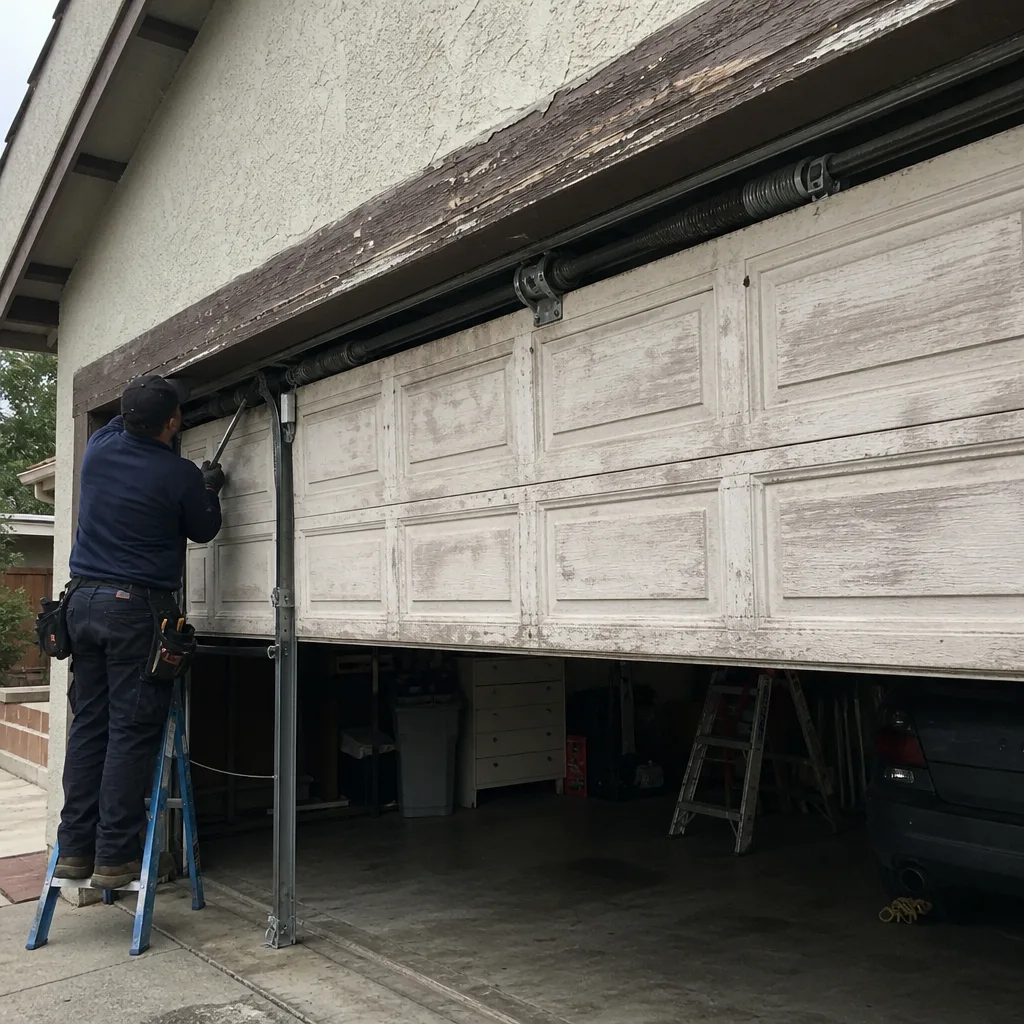 Before
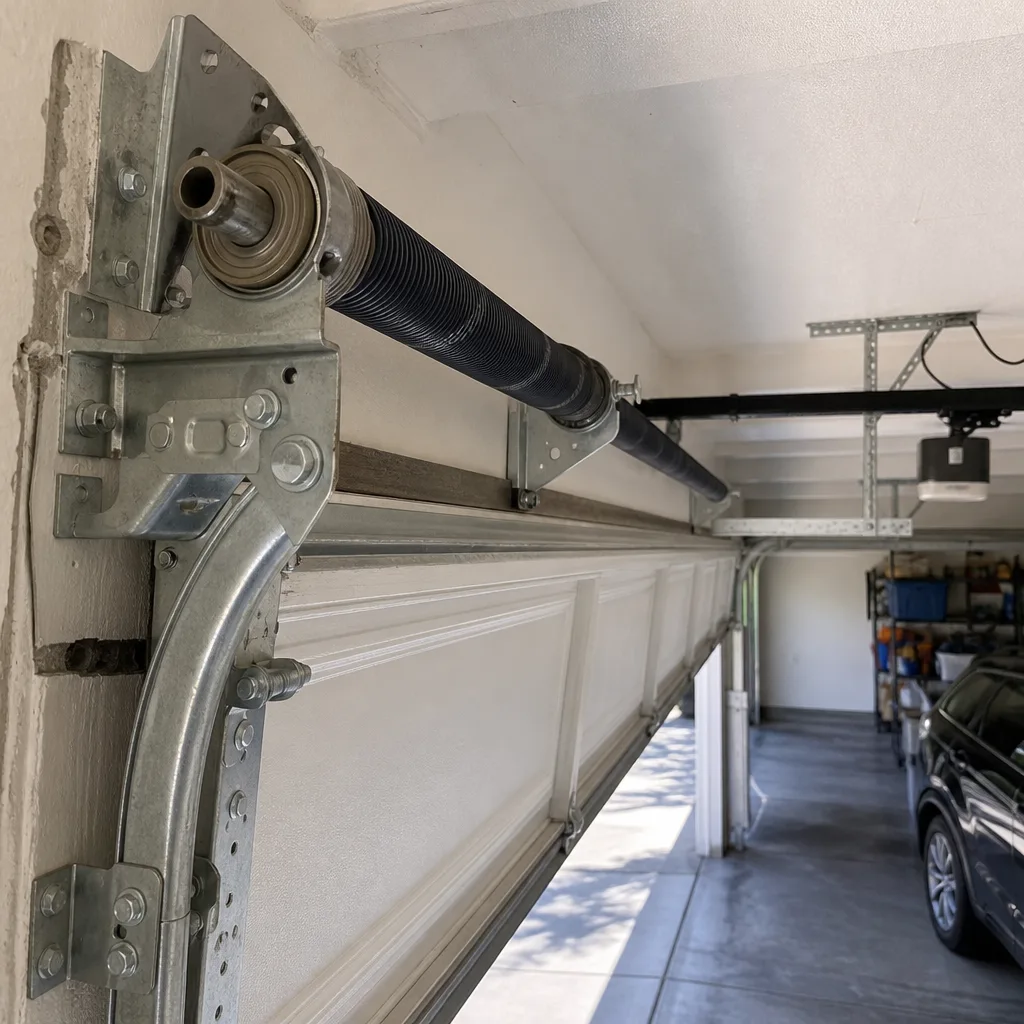 After
 Before
 After
 Before
 After